





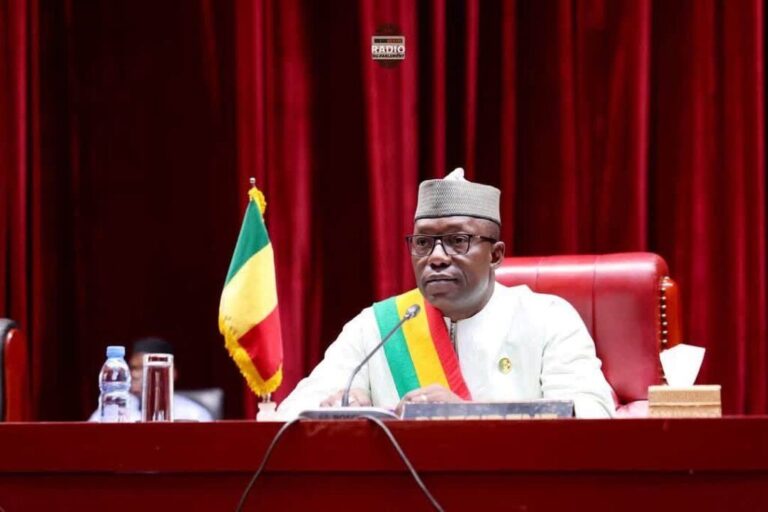
The National Transitional Council in Mali Thursday adopted a bill relating to the general reorganisation of defence and security in the country.
The text reviews the 2004 legal framework in order to adapt it to evolving threats, internal security
and cyber defence.
It was adopted by the Council of Ministers on June 25 before its examination by the legislative body of the transition.
This reform involves rereading the law of November 23, 2004 relating to the general organisation of national defence.
According to the government, the objective is to correct the inadequacies noted in the application of the existing system and to adapt the legal framework to geopolitical, geostrategic and security developments.
The new text introduces several changes to the defence and security architecture. It integrates internal security and cyber defence into the national security system, clarifies the responsibilities between the president, the government and the ministers concerned, and establishes the unity of the operational command around the Chief of General Staff of the Armed Forces within the framework of the operational defence of the territory.
It also provides for the establishment of the National Security Council and the National Defence Committee, as guidance and coordination bodies at the disposal of the president.
These structures replace the Higher Defence Council and the National Defence Committee mentioned in the old system.
Before the members of the CNT, the Minister of Security and Civil Protection, General Daouda Aly Mohammedine, presented the reform as an expected rereading after more than twenty years of application of the old framework. He also mentioned the strengthening of territorial administration, the involvement of traditional legitimacies in the fight against terrorism, as well as the needs for equipment and recruitment.
The text also gives a broader place to territorial administration, communities, decentralised services, civil society and populations in the preparation and implementation of civil defence.
The Ministry of Foreign Affairs is also entrusted with a role in the diplomatic translation of the orientations of the national security policy and in security cooperation.
This adoption comes in a context of persistent security pressure, marked by the coordinated attacks of July 4 against several FAMa positions, notably in Anéfis, Gao, Aguel-Hoc, Sevare and Kenieroba.
It is also part of the broader reorganization of Malian military tools, after the withdrawal of Barkhane in 2022 and the end of MINUSMA in 2023.
MD/ac/Sf/fss/as/APA