



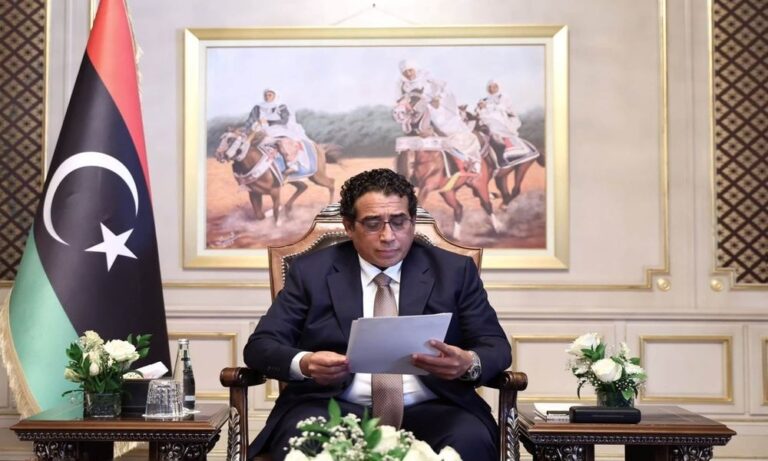
The head of the Presidential Council in Libya, Mohamed Menfi has welcomed any US initiative concerning his country, provided it was supported by the national constitutional institutions.
He made this known during a virtual meeting with the African Union (AU) bureau.
Menfi “in principle welcome the reports of a possible US proposal,” while emphasising that they were currently speculative, as no official proposal had been publicly presented.
He cautioned against the risk that an initiative conducted outside official channels would
exclude Libya’s constitutional bodies, the African Union, the UN-led political process, and key Libyan stakeholders in the situation.
He participated in the session alongside representatives from Burundi, Ghana, Tanzania, and Angola, which was convened by Burundian President Evariste Ndayishimiye, who currently holds the rotating chairmanship of the African Union.
Menfi stated that the African continent faces “complex and constantly evolving challenges,” calling
for closer coordination among member states and the accelerated implementation of the AU’s Agenda 2063. He reaffirmed the principle of “African solutions to African problems,” advocating for the continent’s crises to be addressed through regional and continental institutions, without external interference.
Regarding Libya specifically, he deemed it essential to strengthen the role of the AU, national institutions, and the UN process to preserve the country’s unity, sovereignty, and stability.
These statements come as talks intensify around a power-sharing proposal backed by Washington.
In the east of the country, Field Marshal Khalifa Haftar publicly described it as a “realistic opportunity” to resolve the Libyan crisis, while more than 40 members of the House of Representatives have also expressed their support for the initiative.
Furthermore, the leaders of the three main Libyan political bodies – the House of Representatives, the High Council of State, and the Presidential Council – agreed on a roadmap providing for simultaneous presidential and legislative elections by February 17, 2027, as well as efforts to unify state institutions and undertake economic reforms.
MK/AK/Sf/fss/as/APA