





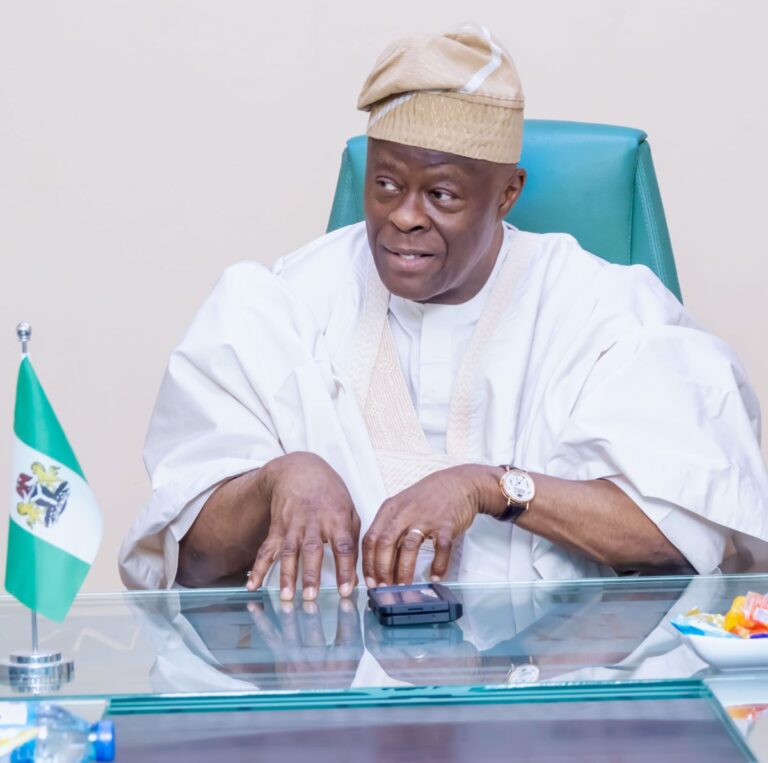
Nigeria’s Minister of Finance and Coordinating Minister of the Economy, Mr. Wale Edun, has urged the country’s banking sector to finance the ideas of young Nigerians so that they do not resort to ecosystems outside their control.
Speaking at the 2025 Investiture Ceremony of the Chartered Institute of Bankers of Nigeria, held at the Wole Soyinka Centre for Culture and Creative Arts, Lagos on Saturday, the minister commended the Central Bank of Nigeria under the leadership of Olayemi Cardoso for its monetary policies, which have helped to stabilise the economy.
Mr. Edun, who was honoured at the event said: “We all know that monetary policy under him (Cardoso) has stabilised the financial system in a most commendable way. We recognise and thank his efforts. Of course, it is a team effort, and those eye-watering interest rates have to be paid by the fiscal side, but the fight against inflation is one in which we all have to participate, so we understand those tight monetary policies,”
“What we heard from the young man was profound, and I would like us to go and think about it some more because he is the future.”
“But he’s pointing out to us that there is work to be done. Each year, about 400,000 graduates enter the job market. Under our President’s current agenda, growth is accelerating, now well above four, and we look forward to sustaining that progress. We have maintained steady reform efforts since May 29, 2023, but what we need now is inclusivity. That inclusivity means creating jobs for our young people.
“No one should have to know someone at the Central Bank or any government office to access banking services or foreign exchange. The market should serve everyone, from large corporations to small SMEs. They should not have to go all the way to Silicon Valley for opportunities.
“As bankers, we have done very well and will continue to do well. Let us remember that if we do not meet their aspirations, which the President is addressing through the rollout of 90,000 kilometres of fibre optic network to drive digital and virtual growth across the country, they will turn to crypto and virtual platforms, and then we will have another problem on our hands,” he added.
In his remarks, the Group Managing Director of United Bank for Africa and Chairman of the Body of Banks’ CEOs, Mr Oliver Alawuba, said that the demand for foreign exchange among customers has dropped significantly due to CBN policies.
“As a banker, a year ago, if you met a customer, he would tell you, ‘Do you have foreign exchange for me?’ Today, if you meet a customer and ask, ‘Do you have any need for foreign exchange?’ he will thank you. It is all thanks to the efforts that you, the Minister of Finance, and the Central Bank of Nigeria have made,” he said.
Alawuba went on to charge bankers to bridge the digital gap with a human face.
He said, “Number one, let us bridge the digital gap with a human touch. As we leverage artificial intelligence, blockchain, and open marketing to enhance performance, we must ensure that no Nigerian is left on the wrong side of the digital transition. Technology is a bridge, not a barrier. Let us innovate with empathy, design for inclusion, and ensure that the heart of banking, which is trust and service, remains human even when the interface is digital.
“Second, let us build processes of trust in a borderless world. With great innovation comes great vulnerability. As our systems grow more interconnected and complex, our collective commitment to safety, cybersecurity, data protection, and the ethical use of AI must be unwavering.
“In this era of digital acceleration and seamless business operations, safety must remain our foremost priority, non-negotiable and of sound mind. Every breach of our best model erodes confidence and threatens the very fabric of progress.
“Third, let us collaborate as we compete. The boundaries we must break next are not just technological, but also territorial and corporate. The future belongs to ecosystems, not just institutions. I call upon my fellow CEOs here, our fintech partners, and regulators to foster a spirit of collaborative innovation. Together, we can build a financial system for Nigeria that is not only efficient and competent but also easier, inclusive, and globally competitive.”
GIK/APA