





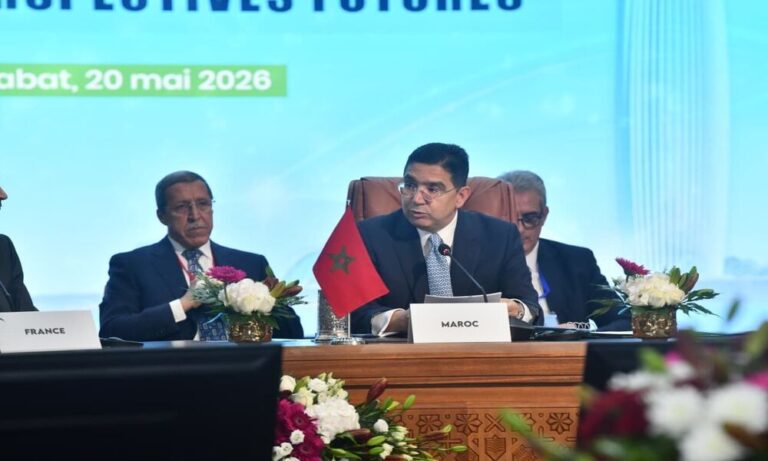
The 2nd Ministerial Conference on Peacekeeping in Francophone Environments was held on Wednesday, May 20, in Rabat, with the participation of 63 delegations representing countries from all the continents.
The 2nd Conference on Peacekeeping in Francophone Environments, co-chaired by the Moroccan Minister of Foreign Affairs, Nasser Bourita, and the French Minister for Europe and Foreign Affairs, Jean-Noel Barro, featured a pre-recorded address by the Secretary-General of the United Nations, António Guterres, who reiterated the “UN80” initiative aimed at ensuring that operations are better adapted to the realities on the ground.
Speaking at the opening of the conference, the Moroccan Minister of Foreign Affairs advocated for UN peacekeeping mandates that are aligned with evolving situations on the ground, “otherwise,” he said.
“They risk becoming instruments of the status quo, instead of genuine levers for conflict resolution.”
The Minister recalled that hosting this Conference in Morocco demonstrates the Kingdom’s deep commitment to the values of peace, cooperation, and international solidarity, in accordance with the Royal Directives.
In his address, Mr. Bourita noted that “peacekeeping operations must be based on realistic, achievable, and prioritized mandates, supported by clearly defined and regularly reassessed political strategies.”
He believes that “it is better to pursue less ambitious but effectively achieved objectives than to maintain unrealistic and unfulfilled promises.”
The Minister further noted that holding this conference comes at a strategic moment for peacekeeping, in a context marked by persistent political divisions within the Security Council, the evolving nature of conflicts, and increasing pressure on available resources.
He also warned of an increasingly hostile theater of operations, marked by asymmetric threats and attacks by non-state armed groups and separatist movements with proven links to terrorist organizations targeting peacekeepers, calling for a zero-tolerance policy towards crimes committed against peacekeeping personnel.
Faced with these challenges, the Moroccan official believes that “the debate should not be about maintaining the status quo versus abandoning it, but rather about the necessary reform of this essential
instrument of multilateralism, in order to make it more flexible, more effective, and better adapted to the realities on the ground.”
He emphasized that peacekeeping operations must remain temporary instruments serving a lasting political solution, and not replace the political will of the parties. In this perspective, the closure of a mission should be considered a plausible scenario when the evolution of the political process and the conditions on the ground allow it, he stressed.
The minister emphasized Morocco’s unique experience in peacekeeping, recalling the Kingdom’s uninterrupted participation since 1960, the deployment of over 100,000 Moroccan peacekeepers to date, and the current presence of nearly 1,340 Moroccan military personnel, primarily within MINUSCA in the Central African Republic (CAR) and MONUSCO in the Democratic Republic of Congo (DRC).
According to the minister, this contribution gives Morocco a particular legitimacy to participate in discussions on reforming peacekeeping operations, advocating for a more effective, safer, and more locally responsive approach.
He also called on the Francophone community to transform its operational weight into genuine political and doctrinal influence, noting that the Francophone space hosts nearly two-thirds of ongoing peacekeeping missions and mobilizes almost 60% of the UN budget allocated to this sector, while its troop contribution remains below its potential.
The minister reaffirmed Morocco’s readiness to contribute to this collective effort, particularly through its Peacekeeping Training Centre of Excellence in Benslimane, while calling for the Ministerial Conference on Peacekeeping in Francophone Environments to be held annually or biennially as a policy framework for guidance and impetus.
For his part, the Secretary-General of the United Nations, Antonio Guterres, stated in a pre-recorded address that peacekeeping is one of the most tangible faces of the UN, at a time when the world is experiencing more conflicts than it has since 1945.
He reiterated that peacekeeping remains one of the international community’s most robust and cost-effective instruments, requiring sustained political commitment, adequate resources and long-term partnerships.
The UN Secretary-General noted that peacekeeping is most effective when based on a clear mandate, the political will of the parties involved, and the unwavering support of Member States.
He added that in Francophone environments, particularly in Africa, language, cultural awareness, the ability to understand local dynamics, and the capacity to build trust are all essential for success.
In this regard, Mr. Guterres recalled the reform he initiated under the UN80 Initiative, a study on UN peacekeeping operations, aimed at ensuring that operations are better adapted to local realities, more coherent, and closer to the people.
Speaking at the meeting, Jean-Noël Barrot emphasized that the Kingdom of Morocco is a key player in peacekeeping and a major partner on the African continent, commending the Kingdom’s numerous initiatives and its commitment to stability, development, and prosperity on the continent.
The French Minister noted that the United Nations peacekeeping operations remain “indispensable,” adding that their effectiveness is “proven,” as evidenced by the active role of UN peacekeepers in areas often far removed from media attention but requiring an impartial presence from the international community. This second edition follows the first Ministerial Conference on Peacekeeping in Francophone Environments, held in Paris in 2016.
AK/Sf/fss/gik/APA