





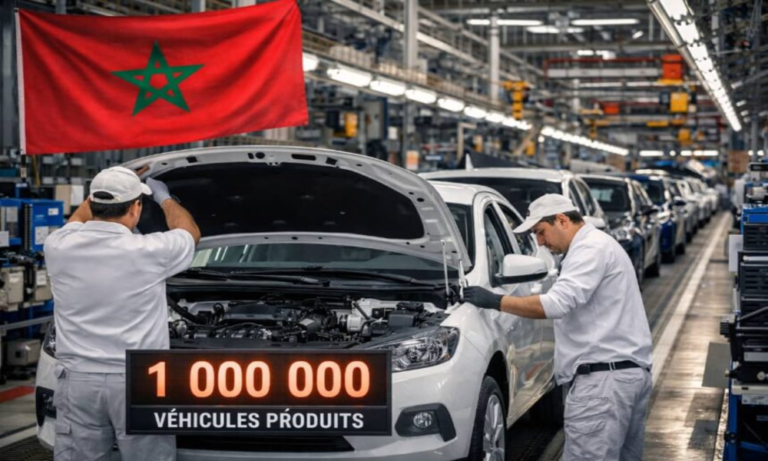
According to the Spanish automotive suppliers association Sernauto, Morocco’s vehicle output is forecast to reach approximately 700,000 units in 2026, as industrial competition with the Iberian Peninsula continues to intensify.
These estimates were presented at a meeting of the industry committee of the Spanish Automotive Suppliers Association (Sernauto), which focused on the sector’s outlook in Southern Europe and the Maghreb.
The meeting brought together nearly forty representatives from thirty-four automotive companies, who reviewed recent trends in the European market and production forecasts for several countries with significant industrial capacity, including Spain, Portugal and Morocco.
According to data presented at the session, Morocco is sustaining strong industrial expansion in the automotive sector — an industry that has become one of the main pillars of its manufacturing base and export earnings. Participants noted that the country is increasingly asserting itself as a growing competitor to industrial sites on the Iberian Peninsula, particularly in the race to attract new investment projects.
Sernauto projections suggest Spain could produce close to 2.3 million vehicles in 2026, a level that would nonetheless remain below pre-Covid-19 pandemic output. Portugal, meanwhile, is expected to maintain production of around 310,000 vehicles, with no significant expansion of its industrial capacity.
The forecasts were based on an analysis of production programs by model and by plant across the industrial sites of all three countries. Industry players are keeping a close eye on production trends across the region as Europe’s automotive sector navigates a period of profound transformation driven by the shift toward electrification and the reorganisation of supply chains.
The committee meeting also welcomed Juan Mocoroa, head of manufacturing engineering at Mercedes-Benz Spain, who presented an overview of the carmaker’s plant in Vitoria. He described the facility as one of the group’s most significant installations in Spain, with over one billion euros in investment and an industrial ecosystem supporting more than 40,000 direct and indirect jobs, alongside a supplier network of approximately 1,400 companies.
MK/ak/sf/lb/as/APA