



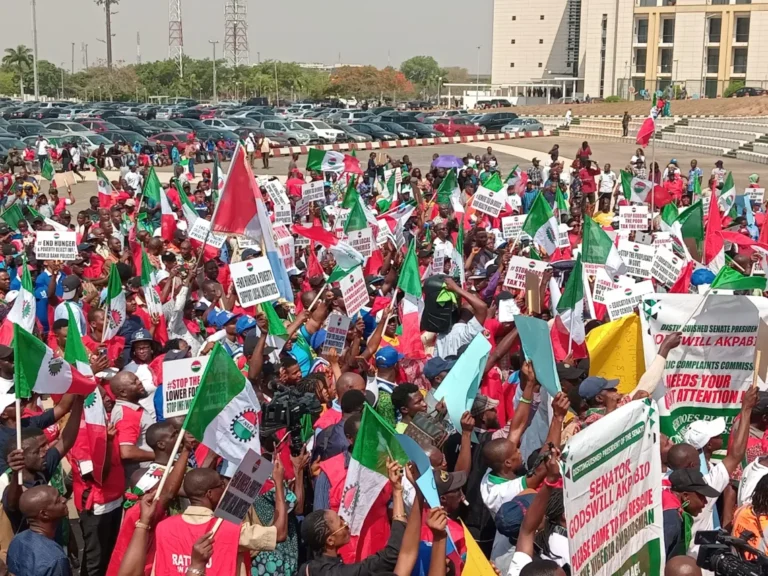
The leaders of the Organized Labour in Nigeria, including the President of the Nigeria Labour Congress (NLC), Joe Ajaero and his Trade Union Congress of Nigeria (TUC) counterpart, Festus Osifo, lamented the worsening economic and political challenges in Nigeria and threatened mass action if conditions do not improve.
In a joint address at the 2026 May Day celebration held at Eagle Square, Abuja, the leaders of the labour unions described Nigeria as a nation where “poverty tightens its grip daily,” institutions are weakening, and citizens are increasingly left to fend for themselves in the face of violence and economic hardship.
Setting the tone early, labour leaders reminded the nation of the central role workers play in sustaining the economy, contrasting it sharply with their current condition.
“Workers remain at the very heart of every industry, every economy, and every success story known to humanity. Without workers, no wheel can turn; without workers, no nation can be built.”
Yet, they lamented, those same workers “create immense wealth yet receive only a fraction of it,” enduring exploitation while “poverty tightens its grip around them.”
They described Nigerian workers as people who “rise before dawn and return home at dusk, exhausted yet unbroken,” but increasingly unable to meet basic needs despite their efforts.
According to the Labour leaders, the macroeconomic indicators have become disconnected from reality.
“We are told that GDP growth may reach about 3.6%… yet poverty continues to rise. We hear official inflation figures… but these numbers do not reflect the reality experienced daily by workers,” they said.
The NLC and TUC argued that Nigeria’s economic model has produced a distorted outcome, saying “Paper growth without jobs, stability without prosperity, and reform without relief.”
They insisted that the benefits of economic policies are being captured by a narrow elite, noting that “An economy that serves only the top 1% while leaving the 99% behind cannot be sustainable. Perhaps, it is working for the ultra-few 1% and not the 99% majority.”
Labour painted a bleak picture of living conditions across the country, citing data that shows poverty now affects about 65% of Nigerians — roughly 150 million people.
“Approximately 10,000 people are pushed into poverty every day,” they said, warning that deprivation has reached “alarming levels.”
Against this backdrop, labour announced that negotiations for a new national minimum wage will begin in July 2026.
“We will commence the process early to avoid the painful delays of the past,” they said.
But beyond future negotiations, the unions demanded immediate intervention:
“We demand that from July of this year, every worker be paid 100% of his basic salary… to cushion the effects of the renewed crisis of survival. We demand a living wage, not a minimum wage.”
On insecurity, labour delivered perhaps its most alarming assessment, declaring that Nigeria is effectively in a state of war.
“The scale of violence, the frequency of attacks, and the mounting loss of lives… place Nigeria among the most dangerous places to live on earth,” they said.
Rejecting the characterization of attacks as isolated incidents, they insisted: “It is not. It is a war against our people.”
They cited killings, bombings, and abductions across multiple states, noting that thousands have died and millions displaced.
“People are no longer safe in their homes, on the roads, or even in their workplaces. Daily life has become a gamble with fate,” they lamented.
GIK/APA
In a joint address at the 2026 May Day celebration held at Eagle Square, Abuja, the leaders of the labour leaders described Nigeria as a nation where “poverty tightens its grip daily,” institutions are weakening, and citizens are increasingly left to fend for themselves in the face of violence and economic hardship.
Setting the tone early, labour leaders reminded the nation of the central role workers play in sustaining the economy, contrasting it sharply with their current condition.
“Workers remain at the very heart of every industry, every economy, and every success story known to humanity. Without workers, no wheel can turn; without workers, no nation can be built.”
Yet, they lamented, those same workers “create immense wealth yet receive only a fraction of it,” enduring exploitation while “poverty tightens its grip around them.”
They described Nigerian workers as people who “rise before dawn and return home at dusk, exhausted yet unbroken,” but increasingly unable to meet basic needs despite their efforts.
According to the Labour leaders, the macroeconomic indicators have become disconnected from reality.
“We are told that GDP growth may reach about 3.6%… yet poverty continues to rise. We hear official inflation figures… but these numbers do not reflect the reality experienced daily by workers,” they said.
The NLC and TUC argued that Nigeria’s economic model has produced a distorted outcome, saying “Paper growth without jobs, stability without prosperity, and reform without relief.”
They insisted that the benefits of economic policies are being captured by a narrow elite, noting that “An economy that serves only the top 1% while leaving the 99% behind cannot be sustainable. Perhaps, it is working for the ultra-few 1% and not the 99% majority.”
Labour painted a bleak picture of living conditions across the country, citing data that shows poverty now affects about 65% of Nigerians — roughly 150 million people.
“Approximately 10,000 people are pushed into poverty every day,” they said, warning that deprivation has reached “alarming levels.”
Against this backdrop, labour announced that negotiations for a new national minimum wage will begin in July 2026.
“We will commence the process early to avoid the painful delays of the past,” they said.
But beyond future negotiations, the unions demanded immediate intervention:
“We demand that from July of this year, every worker be paid 100% of his basic salary… to cushion the effects of the renewed crisis of survival. We demand a living wage, not a minimum wage.”
On insecurity, labour delivered perhaps its most alarming assessment, declaring that Nigeria is effectively in a state of war.
“The scale of violence, the frequency of attacks, and the mounting loss of lives… place Nigeria among the most dangerous places to live on earth,” they said.
Rejecting the characterization of attacks as isolated incidents, they insisted: “It is not. It is a war against our people.”
They cited killings, bombings, and abductions across multiple states, noting that thousands have died and millions displaced.
“People are no longer safe in their homes, on the roads, or even in their workplaces. Daily life has become a gamble with fate,” they lamented.
GIK/APA