



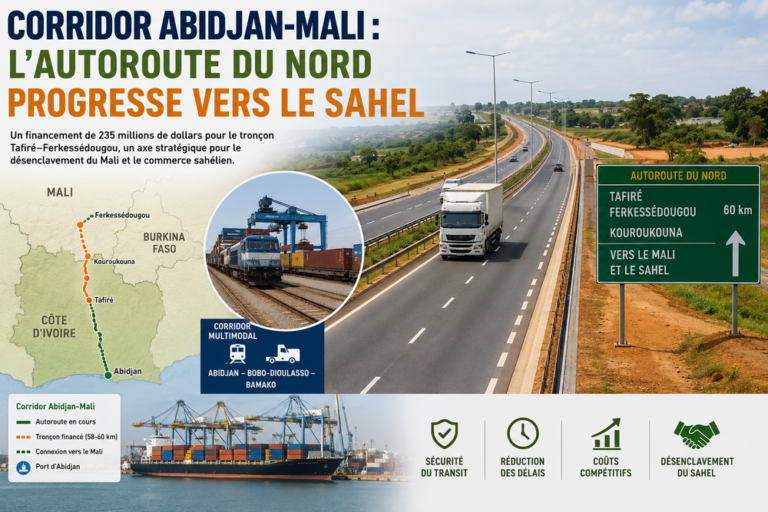
A $235 million loan granted by the Islamic Development Bank (IsDB) to Ivory Coast for the Tafiré–Ferkessédougou section of the Northern Highway is set to bolster a strategic corridor for Mali, which relies heavily on routes connecting coastal ports to the Sahel for its international trade.
Signed on June 19, 2026, in Baku between the Ivorian government and the IsDB, the agreement to finalize the corridor to Mali is valued at approximately 130 billion CFA francs. The funds will finance a 58-to-60-kilometer stretch between Tafiré and Ferkessédougou in northern Ivory Coast, which serves as a key section of the highway designed to link Abidjan to the borders of Burkina Faso and Mali. IsDB project documents divide the construction into two specific lots, namely the Tafiré–Kouroukouna section and the Kouroukouna–Ferkessédougou section.
This project extends far beyond a simple national infrastructure upgrade, forming part of a broader competition among major West African transport corridors, where ports, roads, railways, logistics hubs, and border posts dictate the fluidity of regional trade. While Abidjan aims to cement its status as the premier gateway to the landlocked Sahel, Bamako is closely monitoring any developments that could make freight transport safer, faster, and more cost-effective. As a landlocked country, Mali depends on several maritime access points, including Abidjan, Dakar, Conakry, Lomé, Tema, and Nouakchott. However, the Ivorian corridor remains uniquely important for Malian importers, haulers, and business operators, as fuel, construction materials, food commodities, agricultural inputs, spare parts, and industrial equipment regularly transit via this route to reach Bamako and the country’s primary consumer markets.
The current regional landscape further highlights the significance of this investment, especially since security tensions across several supply routes have underscored the vulnerability of Sahelian roads over the past year. For Malian businesses, logistics decisions are no longer just about choosing a port; they now hinge on corridor reliability, truck availability, transit security, customs clearing efficiency, border processing times, and overall logistics costs, since any disruption ultimately trickles down to local markets and consumers. Data from the Autonomous Port of Abidjan already indicates a strong recovery in transit volumes to the hinterland, with freight destined for Mali and Burkina Faso reaching 3.92 million tonnes in 2025, marking a 34.1% increase. Specifically, volumes bound for Mali surged by 76.4%, jumping from 835,216 tonnes in 2024 to 1.47 million tonnes in 2025, a trend that reflects the renewed appeal of the Ivorian corridor among Malian operators.
This momentum is not limited to road transport alone, as Africa Global Logistics launched an Abidjan–Bobo-Dioulasso–Bamako multimodal corridor in April 2026, combining rail transport to Burkina Faso with road transport into Mali. Utilizing the Bobo-Dioulasso dry port alongside cargo escort systems addresses a growing demand for supply chain traceability, security, and strict adherence to delivery timelines. Ultimately, extending the highway to Ferkessédougou is expected to strengthen logistics continuity between the Port of Abidjan, northern Ivory Coast, Burkina Faso, and Mali, though its final success will be measured less by the capital invested and more by its ability to minimize cargo handling disruptions, secure supply flows, accelerate transit times, and deliver goods to Bamako under more competitive economic conditions.
MD/te/Sf/lb/abj/APA