



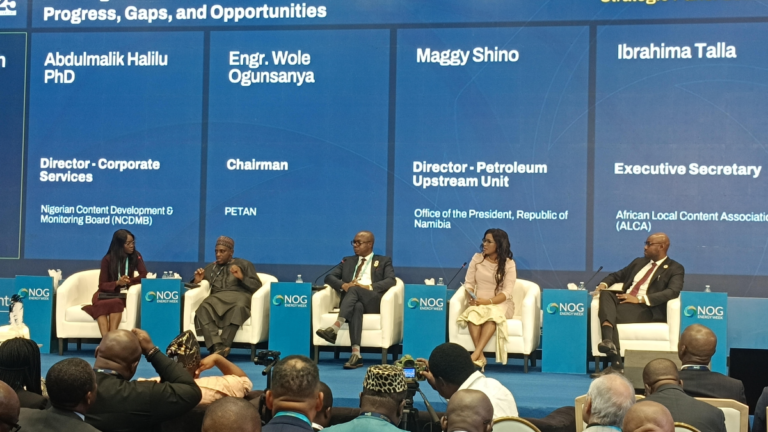
The oil industry experts have called for stronger collaboration among African countries to deepen local content, expand manufacturing and improve access to finance.
Speaking at the panel discussion of the Nigerian Content Seminar at the 2026 Nigeria Oil and Gas Conference, NOG Energy Week in Abuja on Monday, the Director of Corporate Services at the Nigerian Content Development and Monitoring Board (NCDMB), Mr. Abdulmalik Halilu, said that Nigeria’s local content policy had created a governance framework that inspired investor confidence and raised local participation in the oil and gas industry.
He said that the establishment of the NCDMB, the Nigerian Content Development Fund and the implementation targets had strengthened indigenous participation in the Nigerian oil industry, while dedicated financing through development finance institutions had enabled local companies to expand.
Halilu cited the Nigerian Content Intervention Fund, managed with the Bank of Industry, as one of the board’s major achievements, noting that one beneficiary had expanded its fleet from four to more than 15 vessels after accessing a $10 million facility.
He also pointed to growth in local manufacturing, saying Nigerian companies supplied over 2 million metres of cables for the Nigeria LNG Train 7 project and that the country now has an FPSO integration yard.
Despite the progress, Halilu said that capacity utilisation remained a major challenge.
According to him, an NCDMB baseline survey showed fabrication facilities were operating at only about 32 per cent capacity, underscoring the need to accelerate new oil and gas projects to sustain investments already made by indigenous companies.
He added that Africa must prioritise domestic manufacturing because manufactured products account for more than half of engineering, procurement and construction project costs.
Halilu also stressed the importance of research and development, urging African companies to invest in innovation to remain competitive.
Earlier, in his opening address, the Executive Secretary of NCDMB, Dr. Felix Omatsola Ogbe, says that the NCDMB, has unveiled a new phase of Nigeria’s local content development strategy aimed at expanding manufacturing capacity, strengthening industry collaboration and preparing indigenous companies to benefit from upcoming investments in the oil and gas sector.
Dr. Ogbe, who was represented by Abayomi Bamidele, said that the next phase of local content implementation would move beyond compliance and participation to focus on competence, capacity expansion and collaboration.
According to him, the implementation of the Nigerian Oil and Gas Industry Content Development Act has increased Nigerian content in the industry from less than 5 per cent to 61 per cent over the past 15 years.
“Our next phase of local content growth will go beyond participation and compliance. It must move us from capacity expansion. The level of final investment decisions we are seeing is massive and we must position Nigerian service providers to take advantage of those opportunities,” he said.
He noted that although Nigeria has the capacity to support a vibrant manufacturing ecosystem, many local manufacturers still operate below capacity because of limited market access, technology gaps and financing constraints.
To address the challenges, he said, that the board, in collaboration with the Nigerian Upstream Petroleum Regulatory Commission (NUPRC), NNPC Limited and other industry stakeholders, had developed a harmonised contractor grading framework.
Under the new system, companies will be classified into five categories, replacing the different grading systems currently used by various industrial institutions. The framework is expected to support a joint industry capacity audit and simplify contractor certification.
He said that the initiative would eliminate duplication in certification processes, reduce the burden on companies and help ensure that manufacturers with genuine production capacity have direct access to contracts instead of operating through intermediaries.
The capacity audit, he added, would identify Nigerian companies capable of supporting major deepwater developments expected to enter execution, while also creating opportunities for smaller indigenous firms through the new classification structure.
He also announced measures introduced by the board over the past year to improve ease of doing business, including the publication of a Nigerian Content Equipment Certificate, NCEC application guide, new channels for reporting complaints and corruption, and shorter timelines for product certification.
GIK/APA