



The main focus of the accord between Kinshasa and Kigali was a cessation of the conflict in the east of the Democratic Republic of Congo, but there is much more to it.
The world’s mediums have given maximum column inch to the expected end to hostilities and the normalisation of relations between the rival governments of Rwandan’s Paul Kagame and his DRC counterpart Felix Tshisekedi.
The peace agreement was signed in Washington on Friday, drafted around ensuring security, facilitating disarmament of combatants including the M23 militia, and regional integration, sparking both hope and criticism in the same breath.
It commits both parties to respect each other’s sovereignty, cease hostilities, begin the gradual withdrawal of Rwandan troops from Congolese territory, the return of displaced persons, support for the reintegration of former combatants and the establishment of a joint mechanism to monitor these commitments.
While the agreement is widely hailed as a positive step, there is cause for caution.
As the Rwandan and Congolese foreign ministers met in Washington, tensions and violence continue to grip eastern DRC.
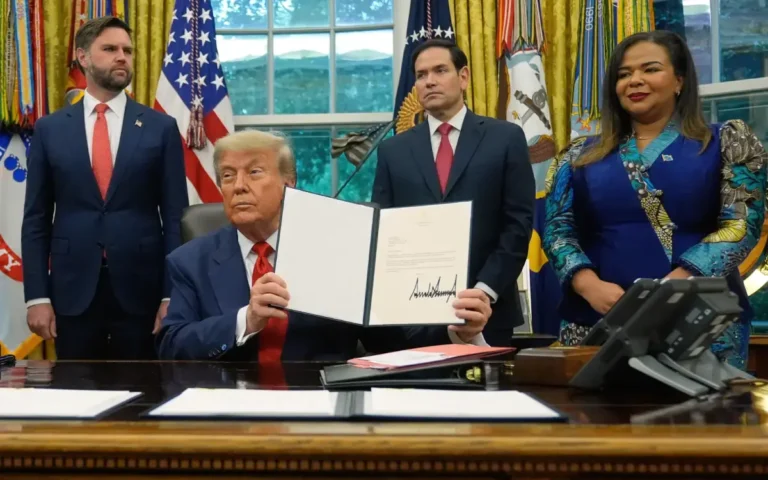
However, the Washington accord under the auspices of none other than US President Donal Trump, while hailed internationally as offering a big breakthrough from some thirty years of bloody conflict in the Great Lakes Region, tells just half the story of American geopolitics.
The other story line which had received just half-hearted attention from the world’s press was that Trump walked away from it all with another deal guaranteeing the United States unfettered access to DRC’s mineral resources.
It is no closely guarded secret that the West led by the United States have long coveted Congolese mineral resources. Washington’s efforts to help stabilise the restive country intersects with its geopolitical and economic interests in the region.
A definitive return to peace in a region blessed with rare earths, will lead to the US government and American companies gaining access to critical minerals such as vast reserves of cobalt, copper, natural gas, petroleum, diamond, gold, manganese, tantalum and niobium, uranium, germanium and zinc.
The unrelenting conflict in the DRC has for years presented a direct impediment to US strategic business interest in the country.
As the world watched Trump berate his Ukrainian counterpart Volodymyr Zelensky at the White House in February over the war with Russia, it became obvious that Washington’s interest in peace blended conveniently with its desire for the endowments in Ukraine. DR Congo was within range of this foreign policy trajectory under Trump.
The US role in the search for what Trump critics say is a mineral-for-peace deal coincides with the global scramble for some of the world’s most coveted minerals many of which are in Africa especially DRC.
According to the African Center of Strategic Studies, the continent is the main focus of this global rush for critical minerals and metals such as lithium, graphite, cobalt, coltan, manganese, platinum, tantalum, and bauxite.
These are required to power modern technologies and manufacturing such as automotive and aeronautical systems, mobile phones, computers, electronics, energy, medical technologies, and steel production, among others.
China is at the forefront of the geopolitics for minerals and accounts for 87 percent of the global processing of strategic and rare earth minerals, according to the center in a recent report.
Keen not to be outpaced by China and other emerging economies, the US is fighting to regain the initiative in regions and countries where their past influence and superpower gravitas was taken for granted but which today’s realities have been unraveling to its bare foundation.
During last year’s Mining Indaba in South Africa, the US under former President Joe Biden demonstrated a serious level of interest in Africa’s mineral resources sector, sending a high powered delegation to one of the most important gathering of stakeholders of the extractive industry.
This interest has been clear in US investment in the Lobito Corridor project, which is building a railroad, a thousand miles long for the transportation of minerals from Zambia and the Democratic Republic of the Congo to an Angolan port.
At a forum in Zambia shortly after the Indaba, the US International Development Finance Corporation announced a new $250 million debt facility to the Africa Finance Corporation to support infrastructure across the continent. The US delegation also struck mining deals.
Writer Alexander Tripp points out in an article last year that ”Just because Washington wants something doesn’t mean that it’ll happen; plus, what the US government wants and what private sector companies do does not always align. For example, while the US was relatively inactive in the minerals sector in Africa, China purchased cobalt mines in the Democratic Republic of the Congo from sources including a US-based mining company. The private sector, and the money and operations it chooses to conduct, will steer the success of projects such as the Lobito Corridor”.
The post-deal optimism in DRC is tempered with expectation that resource extraction would result in economic stability.
Lasting peace in the DRC requires collective action, says Bintou Keita, Head of the UN peacekeeping mission in the country (MONUSCO).
“Priority must be given to dialogue over division, and national cohesion must be actively preserved,” she adds.
As the guns fall silent, the immediate concern in DR Congo will be rehabilitating seven million currently displaced across the country, 27.8 million more facing food insecurity and almost 1.4 million children suffering from acute malnutrition.
WN/as/APA