





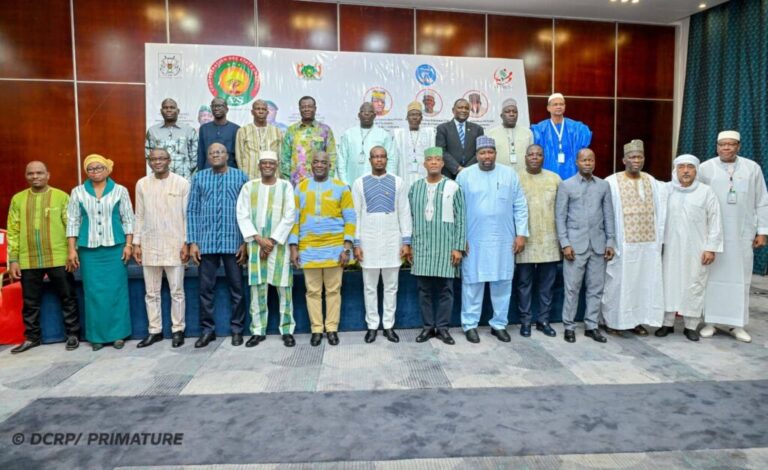
Ministers and economic stakeholders from Burkina Faso, Mali, and Niger have begun high-level discussions in Ouagadougou aimed at accelerating industrialization and boosting intra-AES trade.
With a clear focus on local resource processing and regional economic integration, the proceedings were officially opened this Monday by Burkinabe Prime Minister Rimtalba Jean Emmanuel Ouédraogo. This pivotal gathering follows a series of preparatory expert sessions held on June 13 and 14, where technical teams thoroughly assessed the implementation of past recommendations and formulated strategic proposals to enhance production and streamline trade across the borders of the member states.
During his opening address, the Burkinabe Prime Minister stressed the urgent need to move decisively from political commitments to concrete actions, describing this transition as entirely crucial for the economic development of the Confederation. He identified three core priorities to guide the bloc’s economic future, beginning with endogenous industrialization aimed at processing raw materials locally to eliminate the region’s historical dependence on raw exports. The second priority concerns the active facilitation of intra-confederation trade. Highlighting the scale of the challenge, Afreximbank analyses from the African Trade Report 2024 reveal that intra-African trade remains severely limited, representing approximately 15% of the continent’s total exports, which vividly illustrates the current low level of regional trade integration. The third and final priority focuses on harmonizing regional business regulations to strengthen the protection of local industries and combat unfair distortions of competition.
In terms of raw economic potential, the three nations possess significant and highly complementary resources that unfortunately remain largely unprocessed within their borders. The extractive sector stands out as a massive economic pillar, given that Mali and Burkina Faso are among the largest gold producers in the West African sub-region, while Niger possesses strategic deposits of uranium and oil. Consolidated data from Extractive Industries Transparency Initiative (EITI) reports show that the combined gold production of Mali and Burkina Faso far exceeds 100 tonnes annually, confirming the absolute centrality of gold to their national economies.
However, contrasting World Bank reports on Sahelian economies highlight that these countries continue to be characterized by structurally low levels of industrialization and an over-dependence on exporting primary goods, which heavily limits the creation of local wealth and jobs. Agriculture also remains a dominant sector, employing a large majority of the working population across all three nations, yet it suffers from limited agro-industrial processing that routinely hinders the development of competitive regional value chains.
In light of these shared challenges, regional and international economic institutions strongly agree on the absolute necessity to accelerate economic integration, aggressively develop logistical infrastructure, and strengthen industrial capacity to transform these natural resources into a sustainable growth engine for the Sahel region. Concluding the session on a unified note, the Prime Minister of Burkina Faso—whose country currently chairs the Confederation’s Conference of Heads of State—extended warm greetings to the leaders of the Sahel bloc and paid tribute to the armed forces of the three countries, while the visiting ministers of Mali and Niger firmly reaffirmed their mutual commitment to building a highly productive regional economy.
HO/ac/fss/abj/APA