





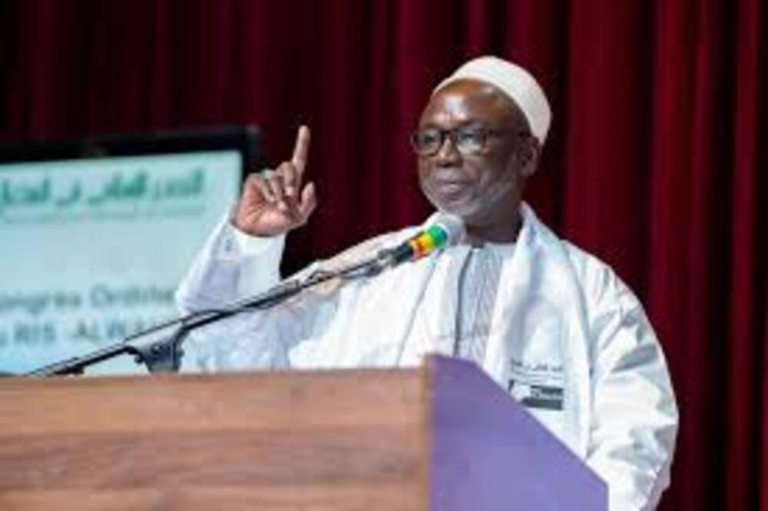
Against a backdrop of persistent political tensions, rising economic difficulties and growing questions over the future of Senegal’s social contract, the Dakar regional coordination of the Islamic Gathering of Senegal (RIS Al Wahda) held a day of discussion and reflection on Sunday dedicated to the country’s major challenges.
Held under the theme “Senegal at a Crossroads: Diagnosing a Society Project in Crisis,” the meeting brought together academics, intellectuals, religious leaders, civil society actors and movement officials in Dakar with the shared aim of analysing ongoing changes and contributing to solutions capable of preserving national stability.
For the head of the RIS Dakar regional coordination, Mouhamadou Lamine Gaye, the initiative reflects the movement’s long-standing civic and educational mission.
“The RIS has always been a space for reflection, education and civic engagement. Today, given the many questions facing our country, it is essential to provide platforms for exchange that allow us to analyse realities and promote solutions based on dialogue, responsibility and solidarity,” he said.
Spirituality, geopolitics and governance at the centre of discussions
The day opened with a session focused on spirituality, health and personal development. Primarily aimed at members and supporters of the movement, it sought to reinforce moral, ethical and civic values seen as essential to building a balanced society.
Participants then turned to major geopolitical issues shaping the international agenda. Conflicts in the Middle East, ongoing instability in the Sahel, and shifts in global power relations were examined in depth. Speakers highlighted the security, economic and diplomatic consequences these crises could have for Senegal and West Africa.
Economic vulnerabilities under scrutiny
Discussions also addressed public debt levels, state budget constraints, relations with international financial institutions, and the daily hardships faced by a significant portion of the population.
Issues related to youth employment, the cost of living, economic competitiveness, and the need to accelerate reforms aimed at supporting inclusive and sustainable growth were also raised.
For several participants, the economy remains at the heart of Senegalese concerns and is a key determinant of social stability.
On the political front, exchanges highlighted continuing tensions in public debate despite the recent change of leadership.
In his presentation titled “Political Crises in Senegal: History and Current Developments,” researcher Dr Saliou Dramé reviewed periods of political tension in the country’s history, stressing Senegal’s ability to maintain institutional balance through a culture of dialogue and consultation.
Participants agreed that political and institutional disagreements should not undermine development efforts or further weaken the social climate.
“When a political crisis becomes entrenched, it is always the population that bears the consequences. It is therefore essential for all actors to work towards de-escalation and compromise in the general interest,” said Mouhamadou Lamine Gaye.
Safeguarding national cohesion against hate speech
Beyond economic and political issues, the meeting also addressed challenges related to social cohesion.
RIS officials expressed concern over the rise of hate speech, insults and forms of stigmatisation observed on certain digital platforms and in parts of public discourse.
According to them, these trends threaten Senegal’s long-standing model of coexistence, religious tolerance and cultural diversity.
“The values of hospitality, brotherhood and mutual respect that have always defined our nation must be preserved. We must reject all forms of discourse that set Senegalese against one another,” the Dakar coordinator stressed.
Participants called for stronger civic education, greater promotion of dialogue, and increased responsibility in the use of social media.
The final presentation, delivered by Cheikh Matar Kébé, president of RIS Al Wahda and political science specialist, focused on “Senegal between Hope and Uncertainty: The Challenges of a New Social Contract.”
He emphasised the need to rebuild trust between citizens and institutions through more inclusive governance, better consideration of social expectations and stronger mechanisms for citizen participation.
According to him, recent political changes offer significant opportunities but also require constant vigilance to preserve democratic gains and consolidate national stability.
Mouhamadou Lamine Gaye said the organisation intends to intensify dialogue initiatives with political, religious and civil society actors in order to help identify concerted solutions to current challenges.
“Senegal has the human, intellectual and moral resources needed to overcome the challenges it faces. However, this requires more listening, consultation and collective responsibility,” he concluded.
Through this meeting, the Islamic Gathering of Senegal aims to strengthen its contribution to public debate and promote a climate of peace, stability and social cohesion in a country undergoing profound political, economic and societal transformation.
TE/Sf/lb/jn/APA