





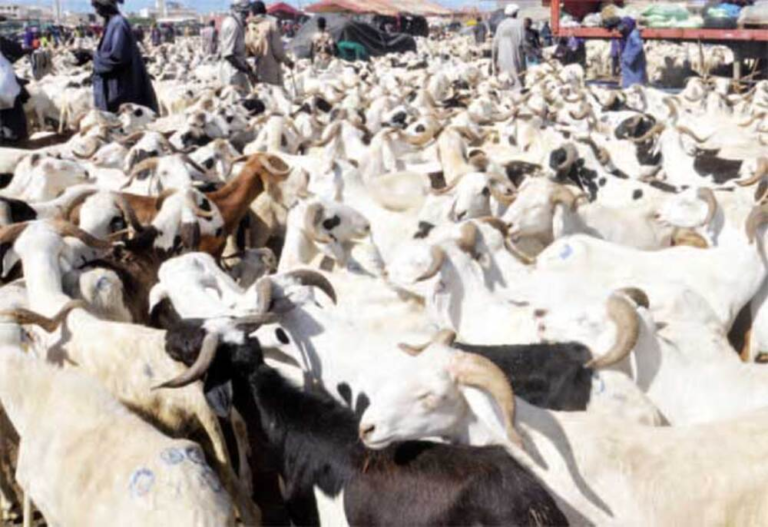
As the Muslim feat of Eid-dul-Adha (Tabaski) approaches, Mali and Senegal are stepping up cooperation on the supply of rams.
On May 5 in Bamako, Mali’s Minister of Livestock and Fisheries, Youba Ba, met with Senegal’s ambassador, Fatoumata Binetou Rassoul Correa, to discuss the needs of the Senegalese market.
As part of a partnership dating back to 2012, Senegal has once again sought Mali’s support to secure sheep supplies for the religious feast.
Malian authorities welcomed the request, reaffirming their willingness to assist a “friendly and brotherly” country, while noting that their commitment will depend on Mali’s own supply capacity.
This cooperation comes against a backdrop of regional security challenges that could complicate the movement of people, goods, and livestock. Despite these constraints, both countries aim to maintain trade flows.
For Senegal, the stakes are high: demand for Tabaski 2026 is estimated at around 860,000 sheep, including 260,000 for the Dakar region alone. The country typically imports between 250,000 and 300,000 of such ruminants, notably from Mali, Mauritania, Burkina Faso, and Niger.
Mali remains a key supplier. In 2025, out of the 282,915 sheep imported by Senegal, more than 84,000 came from Mali. The previous year, this figure exceeded 100,000, underscoring the country’s strategic role in the regional market.
This position is largely due to Mali’s vast livestock population, estimated at several tens of millions of animals across species. Livestock farming is a cornerstone of the national economy, ranking among the country’s main export sectors alongside gold and cotton.
As the holiday nears, several factors will be critical to ensuring smooth supply: market availability, pricing, sanitary controls, border procedures, and security along transport routes.
For both Bamako and Dakar, the objective remains to ensure that Muslim communities can celebrate Tabaski under optimal conditions.
MD/te/Sf/lb/as/APA