





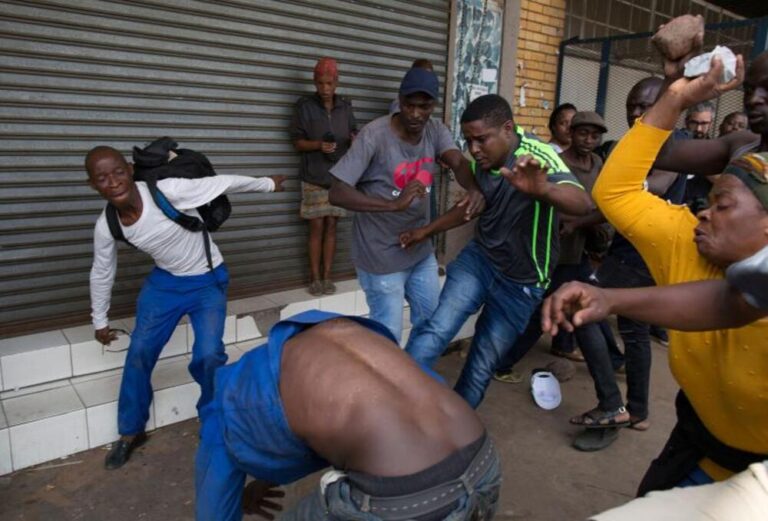
South Africa is witnessing a sharp escalation in xenophobic violence – from school invasions to execution‑style killings – raising renewed fears that anti‑migrant sentiment is being weaponised as the country heads towards the November 2026 local government elections.
What was once sporadic unrest has now morphed into a wave of targeted intimidation, prompting diplomats, civil society and regional leaders to question whether political actors are stoking tensions for electoral gain.
The latest flashpoints have unfolded in Pretoria and Johannesburg where African migrants were urged to remain indoors as anti‑immigration marches gained momentum.
Hundreds of South Africans took to the streets of Pretoria on Tuesday in a protest organised by March and March, heading towards the Union Buildings, the official seat of the government.
Ghana’s high commission advised its nationals to shut their businesses while Nigerian community leaders warned members to stay home.
The marches, framed as protests against “illegal immigration,” have increasingly become platforms for groups such as Operation Dudula whose confrontational tactics have drawn widespread alarm.
This surge comes at a time when anti‑migrant rhetoric has become a potent political tool.
With unemployment stubbornly high and public frustration mounting, foreign nationals – many from Zimbabwe, Mozambique, Lesotho and other neighbouring states – have become easy targets for blame.
Analysts say the timing is no coincidence: as the 2026 elections draw closer, some political actors appear to be tapping into public anger to mobilise support, echoing patterns seen in previous election cycles.
The violence has taken disturbing new forms. Schools, once considered safe spaces, have become battlegrounds.
Videos circulating online show Operation Dudula members storming classrooms to remove children of foreign nationals, triggering scenes of panic as pupils fled.
In one clip, a mother tries to comfort her crying child as shots ring out nearby – a stark illustration of how deeply the crisis has penetrated everyday life.
Elsewhere, the brutality has been more calculated.
In central Johannesburg, an Ethiopian national was recently gunned down at close range in what police suspect was a targeted killing.
CCTV footage shows the attacker calmly approaching the victim before firing and walking away without attempting to rob him.
Days later, a Nigerian trader was confronted by a mob and ordered to leave town despite pleading that he had lived in South Africa for years to support his family.
Police have condemned the attacks as unlawful and contrary to constitutional values, but critics argue that enforcement remains inconsistent and reactive.
The pattern is familiar.
South Africa has a long and painful history of xenophobic violence, with major flare‑ups recorded in 2008, 2015 and 2019.
The 2008 attacks left more than 60 people dead, while the 2019 unrest claimed at least 18 lives, according to Human Rights Watch. Each wave has followed a similar trajectory: rising economic pressure, political contestation, and the scapegoating of migrants.
Regional governments are now sounding the alarm.
Ghana last week summoned South Africa’s ambassador over recent incidents while Mozambique’s Renamo party has urged its government to engage Pretoria urgently.
“The Renamo party is following with deep concern the prevailing situation in South Africa, characterised by intolerance and acts of xenophobia against foreigners, particularly Mozambicans residing in that neighbouring country,” it said in a statement.
Angola has advised its citizens to avoid unnecessary travel.
Zimbabwean writer Jacob Kudzayi Mutisi, in an open letter to the Southern African Development Community and the African Union, warned that “silence becomes complicity,” invoking the continent’s solidarity during the anti‑apartheid struggle.
President Cyril Ramaphosa has repeatedly condemned xenophobia, reminding South Africans of the support they received from neighbouring countries during apartheid. But his appeals for restraint have done little to stem the violence or address the underlying political dynamics.
With groups like Operation Dudula gaining visibility and anti‑migrant sentiment becoming a rallying point, concerns are mounting that the coming months could see further escalation.
As South Africa edges closer to the 2026 elections, the question now confronting the country – and the region – is whether xenophobia is being deliberately inflamed for political advantage.
JN/APA