





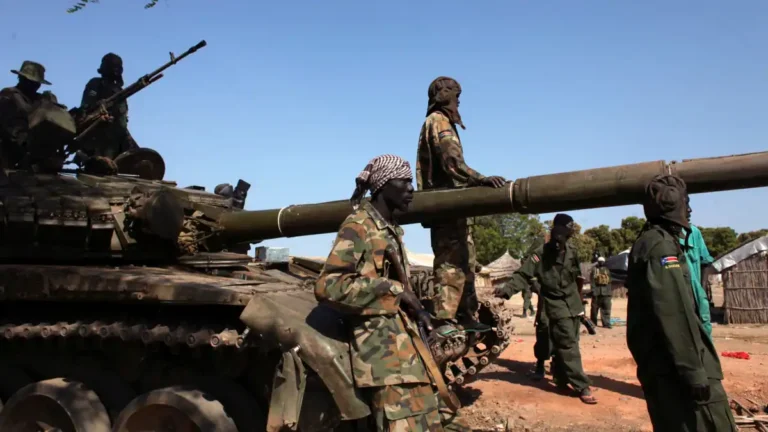
South Sudan faces a renewed slide into full-scale conflict unless urgent international action is taken, the UN-appointed independent investigative body examining human rights there warned.
Addressing the UN General Assembly, the Commission on Human Rights in South Sudan highlighted escalating armed clashes, political detentions, and widespread human rights violations, as the catalyst for a return to civil war.
He called for coordinated efforts to safeguard civilians and uphold justice.
The commission was established by the UN Human Rights Council in 2016 to probe violations in the country and since then its mandate has been renewed annually while its members are not salaried staff.
There is still political tension in the world’s newest country following the detention earlier this year of former first vice president Riek Machar who has since been charged with treason after a seires of attacks blamed on his supporters killed scores of army officers at a base in Upper Nile State.
After years of conflict, a power-sharing government was instituted in 2018 led by Machar’s long term political rival President Salva Kiir. The unity government had held on amid a shaky deal which is rendered precarious in recent months.
Commissioner Barney Afako warned that the oil-rich country’s political transition is in jeopardy because “the ceasefire is not holding, political detentions have become a tool of repression, the peace agreement’s key provisions are being systematically violated, and government forces are using aerial bombardments in civilian areas”.
Afako said there are all indicators that South Sudan is sliding back toward ”another deadly war.”
Fighting intensifies
The UN official said fighting has been intensifying since March, displacing over 370,000 civilians internally and driving many more to neighbouring countries.
Across South Sudan, nearly 2.6 million people remain displaced, in addition to some 600,000 refugees, mostly from Sudan.
“The suffering of South Sudan’s people is not collateral damage – it is the direct consequence of political failure,” said commission chair, Yasmin Sooka.
“Once again, civilians are being bombarded, women are being raped, children are being displaced and forcefully recruited into combat roles, and entire communities are living in fear – all of this is a tragic repetition of South Sudan’s painful past. This war on the people of South Sudan is man-made and preventable.”
Investigators highlighted the growing complexity of the conflict, with political power struggles intertwined with ethnic tensions and local grievances.
The UN official said government reshuffles and partisan appointments have deepened mistrust between signatories to the 2018 Revitalized Peace Agreement, while localised fighting is being exploited for political and military gain.
Billions extracted, ‘while the population starves’
Commissioner Carlos Castresana Fernández linked the crisis to corruption: “Billions in oil revenues have been siphoned off while the population starves. Hospitals have no medicines, schools have no teachers, and soldiers go unpaid while elites enrich themselves through opaque contracts and off-budget deals. Corruption is not a side effect of the conflict — it is one of its engines,” he said.
The Commission’s report also details ongoing sexual violence, forced recruitment of children, and extrajudicial killings, with national authorities complicit in some cases.
Rule of law institutions remain underfunded and promises to reform detention powers have largely gone unfulfilled.
The investigators called on the UN, African Union, and regional partners to ensure accountability, expedite the establishment of the Hybrid Court for South Sudan, and engage the political class in an inclusive process.
Peace will not come through handshakes
“Peace will not come through words or handshakes,” Sooka said. “It will come through concrete actions — ending impunity, protecting civilians, and building institutions that serve people, not power. Justice and accountability must not remain deferred promises. The international community must move beyond expressions of concern to concrete, coordinated action. Otherwise, the suffering will only intensify.”
WN/as/APA