





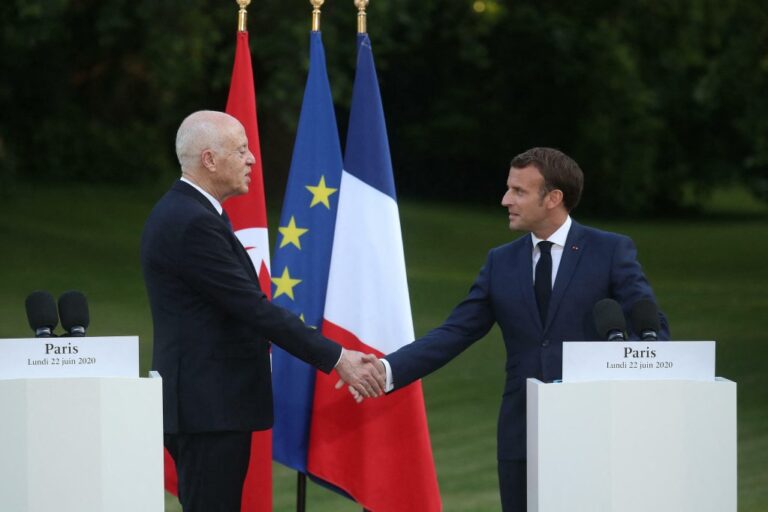
Migration featured prominently as President Kaïs Saïed met with his French counterpart Emmanuel Macron last Friday to mark the 70th anniversary of Tunisia’s independence.
According to an official statement from the Tunisian presidency, beyond the symbolic nature of the meeting, the talks focused primarily on migrants, the Middle East conflict, and the restitution of assets misappropriated under the previous regime.
Migration has emerged as the central pillar of bilateral relations, reflecting a gradual shift toward diplomacy driven by security concerns.
Tunisian authorities reaffirmed their categorical refusal to turn the country into a transit or settlement zone for sub-Saharan migrants. Official figures highlight recent outcomes, according to the International Organization for Migration (IOM), 8,853 migrants were repatriated in 2025. The Ministry of Foreign Affairs now aims to reach 10,000 returns by the end of 2026.
Behind these numbers, Tunisia’s strategy clearly prioritises reducing flows to Europe—particularly Italy—over a comprehensive approach that addresses social and humanitarian dimensions.
This stance is closely linked to the country’s economic constraints. The 2023 memorandum of understanding with the European Union, backed by €150 million, remains a key structural reference.
Observers such as Romdhane Ben Amor from the Tunisian Forum for Economic and Social Rights note that the Saïed-Macron meeting appears to serve the purpose of securing continued financial support. Migration thus becomes a negotiating lever in a context of extremely limited budgetary margins.
However, criticism is mounting over the implications of this approach. Civil society actors argue that dialogue is heavily skewed toward border control priorities, at the expense of the rule of law and migrants’ fundamental rights.
A former Tunisian diplomat observes that this posture reflects both a constraint and a political choice, as the country lacks the structural capacity to manage migration flows independently.
This positioning underscores Tunisia’s growing dependence on European partners. By aligning with Europe’s security priorities, Tunis is effectively engaging in a form of outsourced migration management, potentially weakening its own decision-making sovereignty.
The Saïed-Macron exchange thus illustrates diplomacy under constraint, where migration management increasingly overshadows critical economic and institutional reforms necessary for the country’s stability.
MK/AK/lb/as/APA