





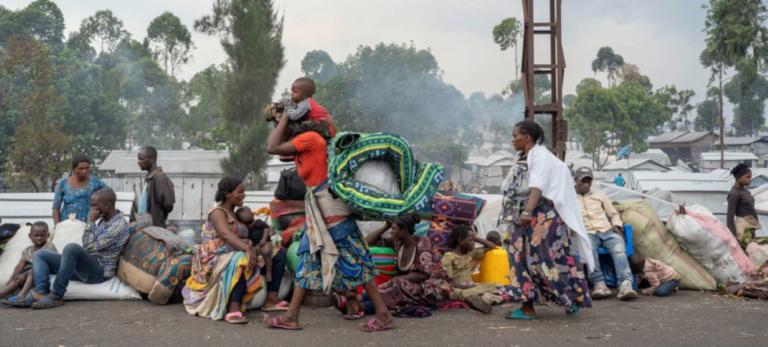
The UN is warning of a rapidly deteriorating humanitarian situation in South Kivu, where fighting between the M23, backed by the Rwandan army, and Congolese forces and the Wazalendo militia has displaced more than 200,000 people and exacerbated an already critical crisis.
The humanitarian situation is deteriorating sharply in the province of South Kivu, in eastern Democratic Republic of Congo (DRC), due to intense fighting over the past week in the territories of Uvira, Walungu, Mwenga, Shabunda, Kabare, Fizi, and Kalehe, the United Nations warned on Wednesday.
More than 200,000 people have fled their homes, while at least 70 civilians have been killed, said Farhan Haq, Deputy Spokesperson for the Secretary-General.
Displaced families, often crammed into overcrowded camps, face increased risks related to protection and disease outbreaks.
According to Radio Okapi, M23 elements were spotted Wednesday in Uvira, marking a new advance for the armed group nearly a year after its offensive that briefly allowed it to seize Goma and Bukavu.
This sudden resumption of hostilities comes just days after the DRC and Rwanda reaffirmed their commitment to implementing the Washington agreement signed in June 2025. Despite this stated commitment, the military situation on the ground has deteriorated considerably.
In the city of Uvira, 32 partner schools have been converted into shelters, disrupting classes and the school meal program for more than 12,000 children. Remaining food stocks are expected to run out within a few weeks.
The escalation has also triggered an influx of people into neighbouring countries: between December 5 and 8, nearly 25,000 people crossed the border into Burundi, while additional arrivals were recorded in Rwanda.
Authorities and humanitarian partners there are increasing the distribution of hot meals, drinking water, and health services.
In Geneva, the UN High Commissioner for Human Rights, Volker Turk, expressed alarm at the plight of civilians and the risk of the conflict spreading regionally, noting that serious violations, including sexual violence, have been documented in Uvira.
The UN Humanitarian Coordinator in the DRC, Bruno Lemarquis, denounced the “devastating” impact of explosive weapons in populated areas and called for their immediate cessation.
Meanwhile, attacks attributed to the ADF continue in North Kivu and Ituri. On the night of September 8-9, 2025, at least 70 civilians were killed during a funeral in Ntoyo, in the Lubero territory, followed by another deadly attack in Fotodu, in the Beni territory.
Response Plan for the DRC remains only 22 percent funded, leaving a shortfall of nearly $2 billion.
Eastern DRC remains one of the most unstable areas on the continent, where dozens of armed groups have been operating for over two decades. By 2025, insufficient humanitarian funding, mass displacement, and escalating violence will exacerbate an already complex crisis.
DM/ac/fss/as/APA