



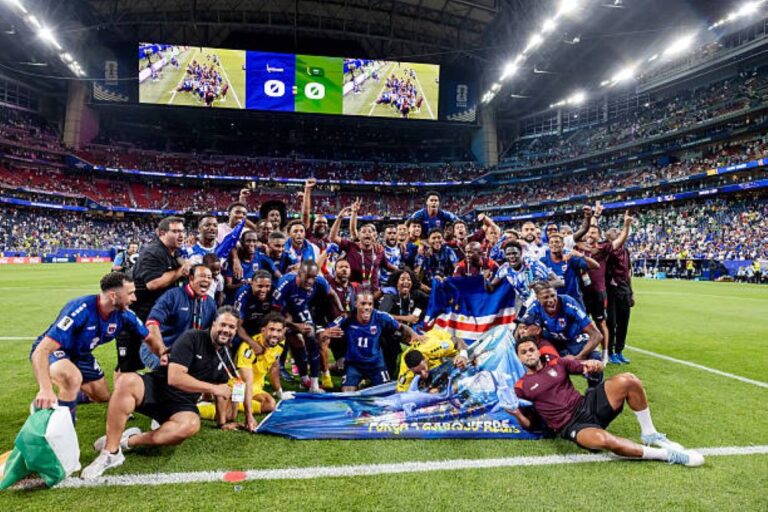
The Blue Sharks may have exited the World Cup following a heartbreaking 3-2 loss to Lionel Messi’s Argentina, but they have captured the hearts and imagination of fooball fans worldwide.
The island nation qualified for the World Cup by beating the likes of continental powerhouse Cameroon in the qualifiers.
Nestled in Group H alongside heavy favourites, Spain, two-time champions Uruguay ad Saudi Arabia, football pundits did not give the island nations of Cape Verde the faintest chance of making the knockout round of 32 even in an expended World Cup of 48 teams.
Going into their group opener as absolute minnows, Cape Verde, a collection of tiny islands off the West African Atlantic coast, captivated the imagination of the world by pulling off the first shock of the tournament, drawing European champions Spain one of the hot favourites of the World Cup, nil-nil.
The star man was 40-year-old goalkeeper, Josimar José Évora Dias or Vozinha put on a man-of-the-match performance behind a resolute defence against Spain who for ninety minutes couldn’t find an answer to the structure that held them at bay sometimes comfortably.
Vozinha made a string of saves (18 saves overall in four World Cup matches) to keep out Spain and all the cameras panned to him as the tearful keeper was mobbed by his teammates who all pointed to him as the player who almost single-handedly gave them their first point at the biggest stage of world football.
It was his moment and he celebrated draped in the colours of his tiny country of just over 500, 000 people, one of the smallest nations ever to make it to the football World Cup.
Many pundits described the match as one of the best 0-0 draws they had witnessed for a long time and signled out the team spirit and cohesion of the Blue Sharks to keep their shape against all the odds. From then on the beautiful story around Cape Verde began building slowly to capture the imagination of football fans irrespective of where their loyalty lie.
Then came the 2-2 draw with two-time champions Uruguay who fell behind from a Kevin Pina freekick, Cape Verde’s first World Cup goal. Although Uruguay levelled and went ahead shortly before half time, Varela struck midway into the second half to force an unlikely draw and second their second point of the group stage.
Needing to win to ensure a place in the last 32, Cape Verde began their final group gae against Saudi Arabia needing to match or better Uruguay’s result against Spain. By virtue of a 0-0 draw, the Blue Sharks emerged Group H runners-up behind Spain who managed to beat Uruguay, dumping them out of the competition.
By now the debutants had drawn the attention internationally to their exploits, dragging their nondescript island nation to instant world recognition recognition. ”Everyone now knows where Cape Verde is on a map” said one elated fan who was in tears as the enormity of the monumental feat by the national team sank in.
Cape Verde’s fairly tale tournament has been so captivating that pundits claimed it is the story of the World Cup so far pushing attention on the highly fancied stars like Lionel Messi, Cristiano Ronaldo, Harry Kne and Erling Haaland to the edge.
The Blue Sharks pushed defending champions Argentina all the way in 120 minutes of knock-out fooball, drawing 2-2 in regulation time before a late own goal by Diney Borges settled the contest.
Sidny Lopes Cabral curling effort, one of the goals of the tournament so far, forced extratime as Cape Verde came from behind twice after Messi and Lisandro Martinez had scored.
Tears flowed freely at the end of the match but many pundits felt Cape Verde had shown the world that it is possible for proverbial dark horses to leave an impression on the biggest stage of world football.
Cape Verde did it without losing a single match in normal time of its four World Cup games and vindicate supporters of an expanded world cup which made it possible by adding into the mix new teams which are rarely seen on the biggest stage of all.
WN/as/APA