





For years now Nigerians and Ghanaians have been locked in a passionate rivalry over who cooks the best Jollof rice but in recent weeks, a more serious issue has stoked up feelings of animosity in Ghana and fear in Nigeria.
Ghanaians say they have grown frustrated by the alleged misbehaviours of some Nigerians living in their midst, demanding stiff sanctions against them including mass deportations to their home country.
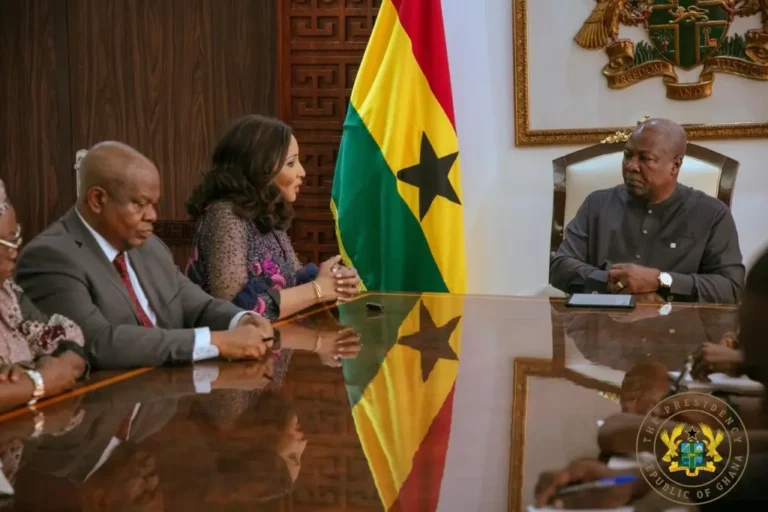
President John Dramani Mahama Monday, moved to allay deportation fears assuring a special envoy dispatched by President Bola Ahmed Tinubu that there will be no such drastic measures targeting Nigerians who had come under strong criticism from Ghanaians for shady activities in Ghana.
A litany of killings, abductions, and growing prostitution is being blamed on Nigerians living in the country.
This anti-Nigerian sentiment follows the controversial bid years ago by an influential Nigerian business tycoon living in Ghana to acquire an Igbo kingship title which Ghanaians believe overstepped the bounds of respectful behaviour expected of a non-citizen who should be respecting the laws of his host country.
Chukwudi Jude Ihenetu has been looking to establish himself as an Igbo king in Ghana since 2013, but was recently rebuffed by the South East Council of Traditional Rulers (SECTR) based in Nigeria.
In a July 16, 2025 letter to the Nigerian High Commissioner in Accra on the issue, the SECTR categorically stated that “the throne and kingship of Ndigbo (Igboman) is situated in the Kingdom or Community of the fatherland and not exportable to foreign lands.”
By this time, the backlash which was felt on social media especially live TikTok platforms went into overdrive marked by angry exchanges between Nigerians and Ghanaians, the latter feeling that they have been too kind to a fault.
The wave of anti-Nigerian sentiments was uncorked in the streets of Accra where protests were staged last week, demanding the immediate expulsion of Nigerians who were apparently taking unfair advantage of the hospitality accorded them by Ghanaians to commit crimes ranging from internet fraud, money laundering, kidnapping, and unlicensed prostitution.
“Our friendly Jollof banter aside, this is about the security and welfare of our country and Nigerians who undermine it should leave” demanded one female protester claimed she understood why Nigerians are distrusted outside of their country.
There were reported fears that Nigerian businesses in Ghana would be targeted with vandalism as the state of bad blood escalated to near-violent rhetoric.
However, during a courtesy call from Nigerian foreign affairs minister, Bianca Odumegwu-Ojukwu, President Mahama assured her that Ghana has no intention of resorting to mass expulsions, emphasising the shared history and the inter-dependence of the two countries.
An estimated 2 million Nigerians have settled in Ghana where many engage in trade and other livelihoods while over 500, 000 Ghanaians live and work in Nigeria.
Mahama reaffirmed Ghana’s commitment to ECOWAS protocols, dismissing any anxieties in Nigeria following the emergence of a viral video in which sought to stir tensions between the two countries.
Minister Odumegwu-Ojukwu conveyed the “anxieties” of the Nigerian people and government, citing the viral video, widespread apprehension of mass deportations, and fears of shops belonging to Nigerian traders being burned.
The concerns, she noted, have led to emergency sessions in Nigeria’s National Assembly and traditional rulers instructing relatives in Ghana to return home.
President Mahama acknowledged the historical relations between Ghana and Nigeria, describing them as “siblings of the same parents, and so our destinies are joined together.”
He invoked past unfortunate incidents of mass deportations in both countries—Ghana in the 1960s and Nigeria in the 1980s—, stating, “I think that that is a part of our past, and it’s an unfortunate past that we want to put behind us, and I believe that none of our two countries should mass deport our citizens ever again.”
“We are members of the ECOWAS, and we have the ECOWAS protocol that allows our citizens to travel freely between our countries.”
He also clarified that, although there have been isolated incidents and some individuals involved in criminal activity, such cases are addressed through proper legal procedures, not through collective punishment or mass expulsion. He stated that foreign residents in Ghana who engage in criminal activities shall be held individually liable and sanctioned.
President Mahama traced the recent tensions to the resurfacing of a 2013 video featuring an “Igbo king” discussing land acquisition for a kingdom, which was widely misinterpreted as a recent development.
He dismissed this as “a bit of a storm in a teacup,” assuring the Nigerian delegation that Ghanaian law governs the establishment of traditional councils, making such external claims impossible.
Mahama’s foreingn minister, Mr. Samuel Okudzeto Ablakwa earlier reassured Nigerians of their safety in Ghana and claimed that the individual behind the inflammatory video has apologized publicly and shown remorse after being reprimanded.
“We must not allow such incidents to overshadow our brotherhood” he added.
WN/as/APA