



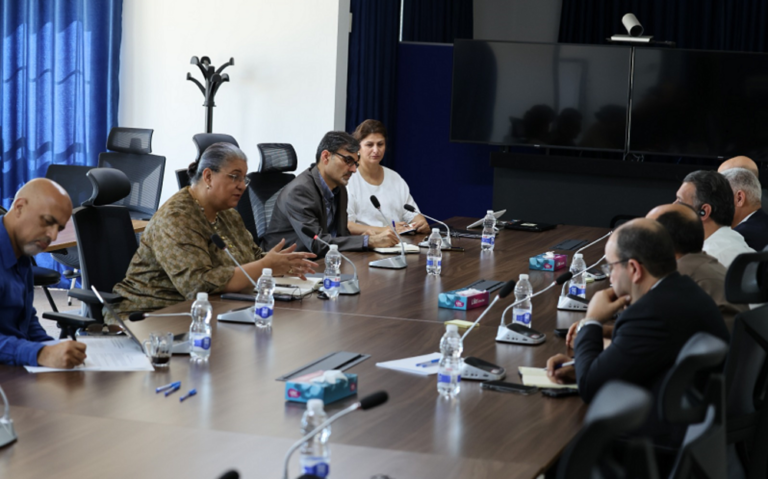
A delegation of officials and prominent figures from Misrata called on the United Nations to strengthen the transparency and inclusiveness of Libya’s political process, as talks on an electoral roadmap continue under UN auspices.
Questions surrounding Libya’s political transition persist despite international mediation efforts. During a meeting with the UN Secretary-General’s Special Representative for Libya, Hanna Tetteh, a
delegation of Misrata figures expressed their concerns about what they consider a lack of transparency in the ongoing initiatives.
According to the United Nations Support Mission in Libya (UNSMIL), the talks focused on the latest political developments, as well as prospects for resolving the institutional crisis that has persisted
for over a decade.
The Misrata representatives, including members of the High Council of State and several public figures, advocated for the implementation of the roadmap recently presented by the UN. They
also stressed the need for a more transparent process to strengthen its credibility with the population.
The delegation discussed the various political initiatives currently under consideration, whether or not they are supported by the United Nations. Its members felt that any approach aimed at resolving the crisis must guarantee broader representation of Libyan stakeholders in order to reduce the risk of renewed tensions and foster the emergence of a lasting national consensus.
They did, however, welcome the conclusions of the structured dialogue established by UNSMIL.
In response, Hanna Tetteh reaffirmed that the initiatives backed by the United Nations were based on the principles of transparency and inclusivity. She emphasised that the primary objective remained the organisation of national elections, enabling Libyans to choose their leaders and end the country’s institutional fragmentation.
These discussions come as several proposals seek to revive the political process. US presidential advisor for the Middle East and Africa, Massad Boulos, recently put forward an initiative to facilitate a power-sharing agreement between the rival authorities, complementing the efforts of the United Nations.
Meanwhile, the leaders of the House of Representatives, the High Council of State, and the Presidential Council announced the adoption of a roadmap outlining the completion of the constitutional and legal framework necessary for holding simultaneous presidential and
parliamentary elections by February 17, 2027.
In her latest briefing to the UN Security Council on June 18, Hanna Tetteh indicated that the structured dialogue had yielded nearly 600 recommendations addressing the country’s main institutional challenges.
While these advances reflect a willingness to revive the political process, persistent disagreements among the various Libyan actors continue to fuel uncertainty about the country’s ability to
achieve a lasting transition.
MK/te/Sf/fss/as/APA