



Benin plans to invest up to $20.77 million in a long-term effort to tackle the degradation of agricultural land, considered one of the main obstacles to improving crop yields.
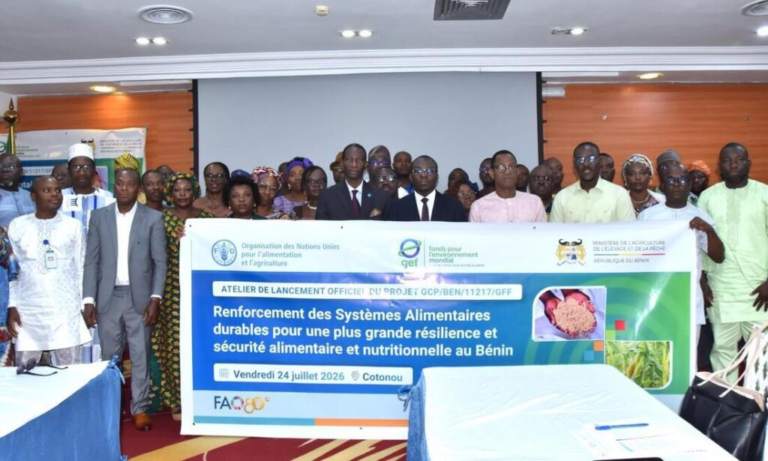
The Beninese government, with support from the Food and Agriculture Organization of the United Nations (FAO) and the Global Environment Facility (GEF), launched on Friday in Cotonou the project “Sustainable Food Systems for Greater Resilience and Food and Nutrition Security in Benin”, also known as Food Systems.
Launched by Minister of Agriculture, Livestock and Fisheries Adin Yeton Bloukounon Goubalan, the project aims to provide a structured response to soil depletion and low agricultural productivity, particularly in the rice and maize sectors.
According to Beninese authorities, a survey conducted in 2019 found that more than 5 million people, representing around 40% of the population, were exposed to land degradation. Nearly 38% of the country’s territory was also considered degraded. This situation is estimated to have reduced agricultural yields by at least 50%, while weakening the incomes and livelihoods of rural communities.
20,000 hectares targeted for restoration
In response to these challenges, the Food Systems project, which will run until 2030, seeks to sustainably transform production systems and value chains for rice and maize. It includes the restoration of 20,000 hectares of degraded land and the adoption of sustainable farming practices across 114,900 hectares.
Around 36,000 farmers and other direct beneficiaries are targeted, while the number of final beneficiaries is estimated at 356,000 people. The project will focus on the municipalities of Karimama, Malanville, Glazoué, Kétou and Aguégués.
The overall project funding amounts to $20.77 million, including $5.97 million from the GEF and $14.8 million in co-financing from the Beninese side.
A major economic challenge
The urgency of the initiative is underscored by the central role of agriculture in Benin’s economy. The sector accounts on average for 26% of GDP, nearly 80% of export revenues and around 70% of employment. Maize and rice, in particular, play a key role in food consumption in both rural and urban areas.
The project aims to simultaneously address public policies, production systems and markets in order to transform value chains into more productive, resilient and environmentally sustainable food systems.
However, the Minister of Agriculture called for caution in selecting soil restoration technologies, stressing the need to assess their relevance and effectiveness before deploying them on a large scale.
For Paul-Henri Zoéwindé Bouda, FAO Representative in Benin, the success of the initiative will depend on the collective commitment of all stakeholders involved, from implementation structures to the beneficiary farmers.
Through Food Systems, Benin aims to break the cycle linking land degradation, low productivity and poverty, while strengthening food security and the resilience of its agricultural sector in the face of environmental challenges.
TE/Sf/lb/as/APA