



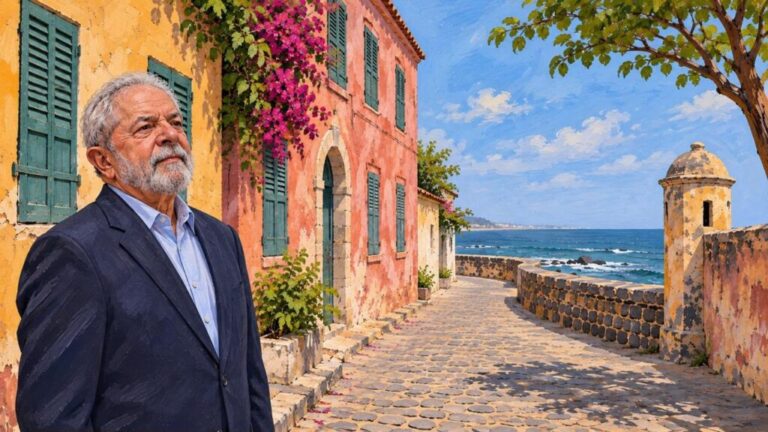
Beneath the cobblestones of Rio de Janeiro’s historic docks lies a history long relegated to the margins of the national narrative, with UNESCO estimating that as many as 900,000 enslaved Africans may have arrived via the Valongo Wharf.
It is precisely from this symbolic point—rather than from the exclusive salons of Brasília or São Paulo—that one must begin to understand the African policy of Brazilian President Luiz Inácio Lula da Silva. Following his re-election on October 25, 2026, with 51.79% of the vote, the president returns to an issue he brought back to the center of public discourse: translating the recognition of a history that profoundly links Brazil to Africa into concrete political action.
For centuries, the forced Atlantic crossing supplied an enslaved labor force for the nation’s sugar plantations, the mines of Minas Gerais, and the coffee estates of the Paraíba do Sul Valley between São Paulo and Rio de Janeiro. Although the Lei Áurea abolished slavery on May 13, 1888—making Brazil the last independent state in the Americas to do so—the late date serves as a reminder of how protracted that freedom was. Focusing solely on the legislation signed by Princess Isabel overlooks those who carved out their own liberation, such as the quilombos, whose descendants preserve a legacy of resistance. This enduring African presence is reflected in cultural practices like capoeira and in official state statistics, where the 2022 census recorded 10.2% of the population identifying as “preta” (Black) and 45.3% as “parda” (mixed-race), together accounting for 55.5% of the population based on self-identification.
Economic data, however, highlights disparities for these majority groups. In 2024, workers from these categories earned an average of 15 Brazilian reais per hour, roughly $2.72, compared to 24.6 reais, or about $4.47, for white workers. This gap creates an internal imperative for Lula’s Africa-focused diplomacy: acknowledging African heritage while simultaneously combating the inequalities affecting its descendants. On May 19, 2025, addressing African agricultural ministers in Brasília, Lula asserted that Africa is part of Brazil and that his country should take pride in recognizing itself as part of Africa. This commitment builds upon his 2003 legislation mandating the study of Afro-Brazilian history and culture in schools and his 2005 apology on Gorée Island in Senegal for the suffering caused by slavery, embedding this legacy into the national narrative passed to younger generations.
Nevertheless, it would be incorrect to credit Lula with originating Brazil’s Africa policy. On November 11, 1975, amid the Cold War, Brazil’s military regime became the first nation to recognize an independent Angola, and by 1986, it spearheaded the creation of the South Atlantic Peace and Cooperation Zone at the United Nations. These milestones demonstrate that Brasília maintains strategic interests across the ocean, where maritime security and international alliance-building provide a logic transcending purely cultural affinities.
At the opening of the African Union summit in Addis Ababa on February 17, 2024, Lula stated that Brazil aims to grow alongside Africa without dictating paths, highlighting university scholarships, public health, deforestation monitoring, and permanent seats for African and Latin American nations on the UN Security Council. This cooperation has generated tangible projects, such as a state-owned pharmaceutical plant in Mozambique operating since 2012 with support from Brazil and the Oswaldo Cruz Foundation (Fiocruz), which originated from a 2003 partnership aimed at transferring skills and developing local production capacity.
Ultimately, Brazil seeks allies to shape international rules and must be open about its expectations, while true reciprocity will be measured by the capacity of African states to assert their own priorities regarding project selection and financing. Lula will face scrutiny on both sides of the Atlantic; in Luanda and Dakar, observers will evaluate which initiatives survive beyond official declarations, while domestic assessment in Brazil will unfold across universities, pay slips, and political corridors to determine whether paying tribute to those brought by force to Rio de Janeiro translates into granting their descendants their rightful place in society.
GDP/Sf/fss/abj/APA