



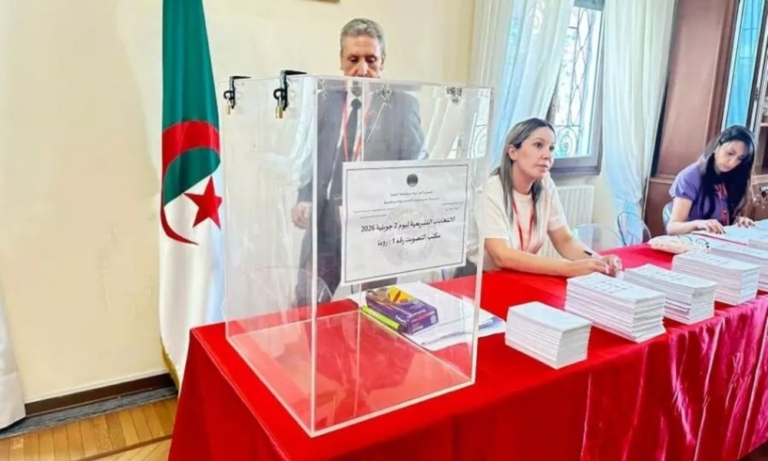
Algerians living abroad have begun casting their ballots for the country’s legislative elections scheduled for 2 July, as campaigning at home enters its final hours amid renewed calls for a strong voter turnout.
Voting operations for the parliamentary elections have officially opened for Algerian citizens residing overseas, in line with the timetable established by the National Independent Election Authority (ANIE).
A total of 854,285 registered voters abroad are eligible to participate, out of a national electorate of 24,727,041 voters. Twelve seats in the National People’s Assembly (APN) have been allocated to the diaspora, compared with eight in the previous legislature.
According to ANIE, 66 lists representing political parties and independent candidates are competing for the diaspora seats. Voting has already begun in several countries, including Tunisia, Italy, Belgium and Luxembourg.
Polling stations will remain open daily from 8:00 a.m. to 6:00 p.m. until 2 July, with extended hours until 8:00 p.m. on election day to facilitate participation. Algeria’s electoral law also allows proxy voting under specific conditions through diplomatic and consular missions.
Electoral authorities said campaigning among overseas voters combined in-person outreach by candidates with extensive use of digital platforms. In Tunisia, 15,126 Algerian voters are registered through consular districts covering Tunis, Le Kef and Gafsa. Italy falls under the eighth overseas electoral constituency, administered from Madrid and encompassing 14 countries across Southern and Eastern Europe, as well as Turkey.
Meanwhile, campaigning within Algeria is set to conclude at midnight on Sunday before the start of the mandatory electoral silence period. As polling day approaches, major political parties have intensified appeals for voter mobilisation, with turnout emerging as one of the central issues of the election.
Louisa Hanoune, Secretary-General of the Workers’ Party (PT), called for stronger protection of rights and freedoms and advocated broader access to the media landscape.
Youcef Aouchiche, First National Secretary of the Socialist Forces Front (FFS), urged citizens—particularly young people—to participate massively in the vote and contribute to political life.
Atmane Mazouz, leader of the Rally for Culture and Democracy (RCD), described the legislative elections as an important step in consolidating the rule of law.
Meanwhile, Tahar Benbaïbeche, president of El-Fadjr El-Djadid, promoted a platform focused on youth, education and combating drug use.
MK/AK/Sf/lb/as/APA