





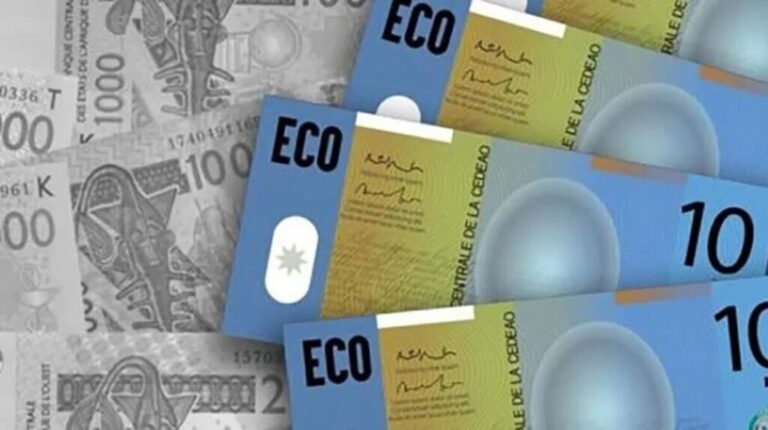
Seven months after expressing concerns about delays in macroeconomic convergence, the Economic Community of West African States (ECOWAS) has reaffirmed its ambition to launch the ECO single currency in 2027.
The heads of state now favour a phased implementation, initially limited to countries meeting the convergence
criteria.
The heads of state and government of the bloc reaffirmed their commitment to launching the ECO single currency in 2027, while opting for a phased approach that will allow only those states meeting the convergence criteria to join the first phase of the project.
Meeting on Sunday, July 19, in Lungi, Sierra Leone, for their 69th Ordinary Session, the West African leaders presented the ECO as a key lever for deepening regional economic integration and promoting sustainable, resilient, and inclusive growth.
They decided that the single currency will first be adopted by countries ready to participate, while support will be provided to other states to facilitate their subsequent accession.
This approach marks a shift from the Abuja summit of December 2025, where the Conference of Heads of State expressed concern about insufficient progress on macroeconomic convergence and delays in implementing the ECO roadmap.
At that time, the leaders called on member states to adopt economic policies that would meet the convergence criteria and requested the reactivation of the Presidential Task Force responsible for the single currency program.
In Lungi, the Heads of State welcomed the high-level consultations undertaken between the ECOWAS Commission and the central bank governors to reach a consensus on the remaining technical issues.
They also welcomed the registration of the “ECO” trademark with the African Intellectual Property Organization (OAPI), which they presented as an important step towards realising the project.
The conference also approved Guinea’s request to join the Presidential Task Force on the single currency program and instructed the commission to convene a meeting of this body before the ordinary summit in December 2026, in collaboration with the president of Côte d’Ivoire, the only remaining member of this working group.
Finally, the leaders asked the ECOWAS Commission and the West African Monetary Agency (WAMA) to intensify consultations with central banks in order to formulate consensus proposals on the remaining issues and
to pursue the international registration of the “ECO” trademark with the relevant intellectual property bodies.
The ECO project aims to replace the various currencies currently circulating within ECOWAS with a common currency. However, member states currently operate under separate monetary systems.
Some of these countries use the CFA franc, issued by the Central Bank of West African States (BCEAO) within the framework of the West African Economic and Monetary Union (UEMOA), while others have their own national currencies, such as the Nigerian naira, the Ghanaian cedi, the Gambian dalasi, the Liberian dollar, the Guinean franc, the Sierra Leonean leone, or the Cape Verdean escudo.
The launch of the ECO will also have to contend with the new political landscape of West Africa. Although Burkina Faso, Mali, and Niger have left ECOWAS, the three countries remain members of UEMOA and continue to use the CFA franc.
The final communiqué does not specify what their place will be in the future regional monetary system, while ECOWAS has confirmed a gradual launch of the ECO from 2027.
This question could constitute one of the main challenges of the project, in view of the monetary links that these three states continue to maintain with the UEMOA space.
AC/Sf/fss/as/APA