



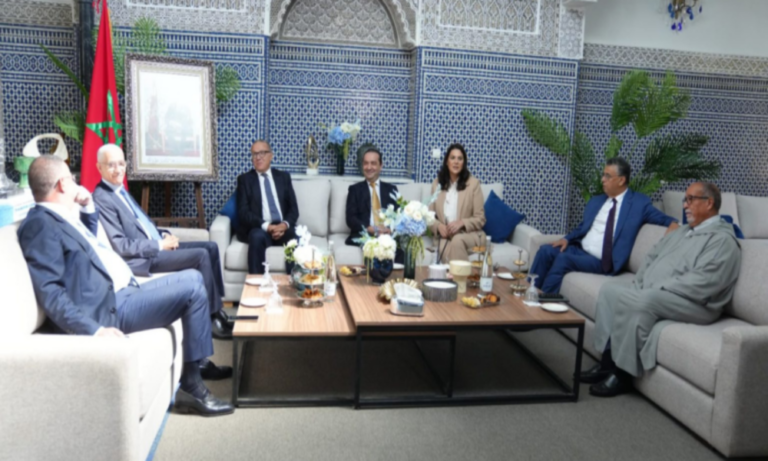
Morocco’s new head of government, Fatima Ezzahra El Mansouri, began consultations on Wednesday to form a new government, holding separate meetings with the leaders of the National Rally of Independents (RNI), the Istiqlal Party, the Popular Movement, the Socialist Union of Popular Forces (USFP) and the Party of Progress and Socialism (PPS).
A day after being appointed by King Mohammed VI as head of government and tasked with forming a new cabinet, Fatima Ezzahra El Mansouri launched consultations with political parties in Rabat on Wednesday, 30 September.
The first round of talks began with the National Rally of Independents (RNI), followed by the Istiqlal Party, the Popular Movement (MP), the Socialist Union of Popular Forces (USFP) and the Party of Progress and Socialism (PPS).
The first party leader to meet El Mansouri was RNI President Mohamed Chaouki, who was accompanied by Rachid Talbi Alami and Mohamed Boussaïd. After the meeting, Chaouki praised the King’s confidence in Fatima Ezzahra El Mansouri, describing the appointment of the first woman to head the government as a “historic moment in Morocco’s political history”.
The RNI president described the discussions as “responsible”, marked by “clarity and frankness”, and focused on the challenges facing the country and the head of government’s vision for the next phase. Without explicitly commenting on the role his party might play in the future governing majority, he stressed the RNI’s position, saying that its contribution would continue to place “the supreme national interest” first.
The Istiqlal Party, for its part, provided an initial indication of its decision-making timetable. Its Secretary-General, Nizar Baraka, announced that a session of the party’s national council would be devoted to assessing the election results and considering whether to participate in the next government. He nevertheless said that, whatever position the party takes in the next political configuration, the PI intends to support the new phase.
The Istiqlal secretary-general placed restoring confidence in political action at the centre of the challenges ahead, noting that this would require, among other things, honouring promises and commitments contained in election programmes and strengthening the credibility of public action. Baraka called for a shift after the elections from partisan competition to mobilisation in response to the country’s challenges. He cited employment, unemployment, protecting purchasing power and territorial integrity among the issues concerned.
Consultations then continued with the Popular Movement. Its Secretary-General, Mohamed Ouzzine, congratulated El Mansouri on the Royal confidence placed in her and wished her every success in carrying out her constitutional duties.
The MP leader highlighted the importance of respecting the democratic approach and the constitutional and legal framework underpinning the appointment of the head of government. He also said that a woman’s accession to the head of the executive reflected the place accorded to women in Moroccan society.
According to Ouzzine, the talks covered several challenges directly affecting citizens. He stressed young people’s expectations, the creation of employment and entrepreneurship opportunities, and integrated territorial development. Several strategic issues were also discussed, foremost among them the issue of Morocco’s Western Sahara enclave.
The USFP was represented at the talks by its First Secretary, Driss Lachgar. He particularly stressed the significance of Fatima Ezzahra El Mansouri’s appointment, recalling the central place occupied by women’s rights in his party’s positions.
He described the appointment of a woman to head the government for the first time as a “qualitative step forward” in Moroccan society’s progress towards greater equality between women and men.
According to Lachgar, the talks also provided an opportunity to review several political issues and developments. The USFP First Secretary, however, declined to disclose further details of the discussions, saying he preferred to wait until the head of government had completed her consultations with the various political parties.
The first day ended with a meeting with the Party of Progress and Socialism (PPS). Its Secretary-General, Nabil Benabdallah, welcomed the symbolic significance of appointing a woman to head the government for the first time in Morocco’s history. He expressed hope that the new phase would give fresh impetus to efforts to advance equality between women and men.
Consultations on forming the new government are due to continue on Thursday with other political parties, including the Party of Justice and Development (PJD). The party’s leader, Abdelilah Benkirane, has already said that the question of participation in a government led by the PAM has already been settled.
The PJD secretary-general said on Wednesday, 30 September 2026, that a meeting with El Mansouri would not alter the decision taken by the PJD’s governing bodies not to join the next governing majority.
At an extraordinary session held in Bouznika on Saturday, 26 September 2026, the PJD national council unanimously approved the decision to remain in opposition and not participate in the next government.
El Mansouri had made clear that the PAM, whose collective leadership she coordinates, had “no red lines” regarding alliances and remained open to all national political parties.
The opening of the first parliamentary session is scheduled for 9 October 2026, followed by the presentation of the new majority’s government programme.
AK/Sf/lb/as/APA