



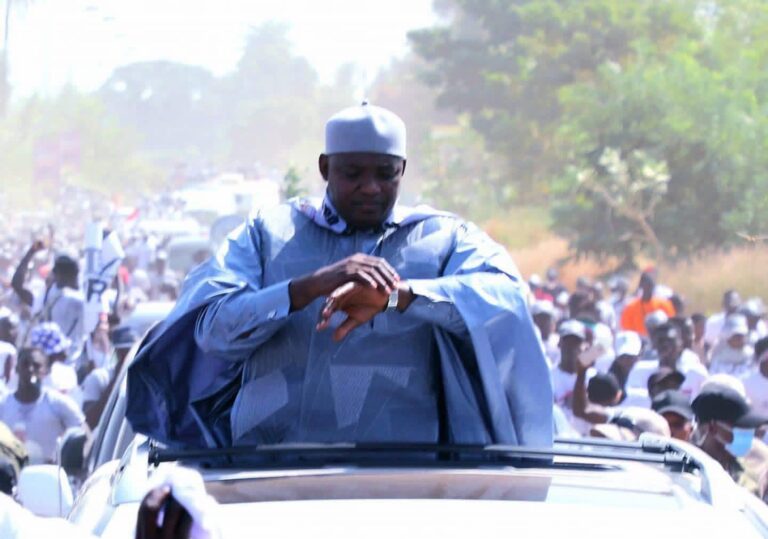
President Adama Barrow has made his official bid for a controversial third term by submitting his nomination papers at the Independent Electoral Commission on Tuesday.
The Gambian leader in the past said this would be his final term as president.
Flanked by his two wives in a sea of thousands of grey-wearing militants of the ruling National People’s Party (NPP), President Barrow confidently waved to the tumultuous crowds as his motorcade made its way to the IEC foreground.
Barrow 61 became Gambia’s third president after unseating predecessor Yahya Jammeh in the December 2016 presidential vote. He was re-elected five years later, defeating former political ally and main challenger Ousainu Darboe of the United Democratic Party.
Appearing before IEC chairman Joseph Colley, President Barrow was guided through the process of the nomination bid which requires proof of citizenship, income tax clearance, asset declaration, a deposit of D1million and at least 5000 signatories coming from his party.
Following this procedure, IEC chair Colley informed Presidnt Barrow about the signing of a political peace pact by stakeholders involved in the elections.
Facing the media shortly after filing in his nomination, a smiling President Barrow dressed in NPP colours, told journalists that the ten-year track record of his administration speak to deepening peace and general infrastructural development unprecedented in the country’s history.
In his few points, the estate developer-turned president said his Yiriwa (growth in Mandinka) Agenda would witness continuity in securing greater access to electricity to far-flung corners of the country, prosperity in agriculture. He also emphasised that the bedrock of the country’s development is peace and stability.
When tasked by journalists on term limit, President Barrow said although he believes in such a principle, he has no cause to turn down a popular call for him to continue with his development agenda for the country. He cited a country like Germany where he said effective leadership does not necessarily depend on the values of term limit for its leaders past and present.
However, he promised to improve the constitution by introducing term limit should he win the high-stakes December 5th presidential vote.
Barrow styles himself as a man of presidential experience and symbolises continuity unlike his opponents who are yet to be tested in the hot seat of ultimate Gambian political power.
The incumbent faces stiff challenge from his former political godfather Ousainou Darboe who at the head of an alliance of opposition parties on Monday made his nomination bid at the IEC accompanied by thousands of UDP militants.
Gambia’s election year has witnessed a series of behind-the-scenes negotiations and horse-trading among some of the country’s biggest political groups with a view to forming electoral alliances.
Barrow’s NPP pulled off a propaganda coup over their rivals after Mamma Kandeh’s Gambia Democratic Congress, which came third in the 2021 presidential election, and erudite lawyer Essa Faal threw their weight behind the ruling party.
Darboe 78 faces his sixth and final bid for the Gambian presidency after failing in 1996, 2001, 2006, 2011 and 2021. He was jailed by the government of then President Yahya Jammeh during the 2016 presidential vote when current President Barrow then a member of Darboe’s UDP, pulled off a shock victory.
Mr. Darboe served as foreign minister and vice-president under President Barrow before the two political proteges fell out in 2019.
Most polls before the December vote suggest a two-horse race between Barrow’s ruling NPP and perennial UDP opposition leader Darboe.
Analysts give opposition United Movement for Change of young former mayor Talib Ahmed Bensouda an outside chance at December’s polls.
1.1 million Gambians have been registered by the IEC ahead of the polls.
WN/as/APA