



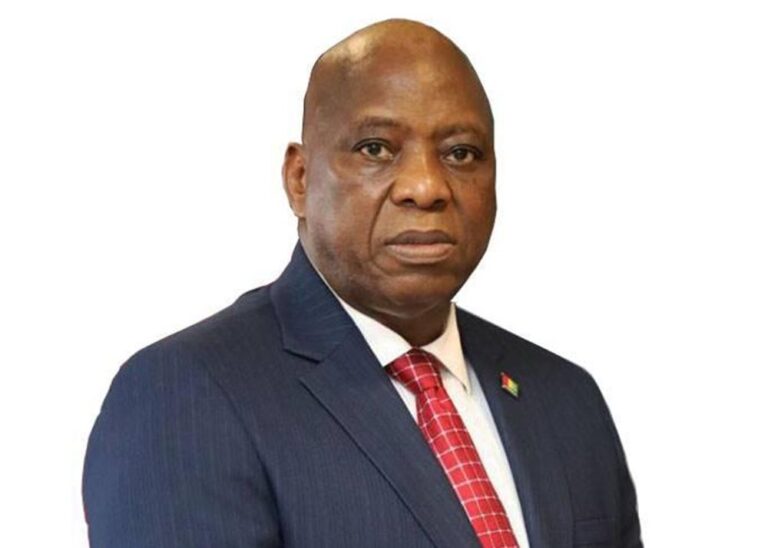
Guinea’s foreign minister Morissanda Kouyate has been defending government policy against illegal gold mining, asserting that Pan-Africanism and solidarity among African nations should not be misconstrued as signs of weakness when it comes to activities that damage the country’s
natural resources.
Addressing ambassadors accredited to Guinea, the foreign minister noted that President Mamadi Doumbouya views Pan-Africanism as solidarity between the continent’s states – a principle exemplified by Conakry’s refusal to join ECOWAS sanctions against Mali.
“They have mistaken the President’s – and Guinea’s – vision of Pan-Africanism for weakness,” Morissanda Kouyaté stated, referring to instances where foreign nationals returned to gold-mining areas after having been repatriated to their home countries.
The minister explained that the Guinean authorities were alerted by the local population in Siguiri to the consequences of unregulated gold mining, citing issues such as the use of cyanide, deforestation, the destruction of wildlife, and the degradation of waterways.
According to him, these practices also undermine the government’s environmental preservation efforts – most notably the “Simandou 2040” Project, which is contingent upon strict environmental standards.
Morissanda Kouyate also pointed out that the ban on clandestine gold mining is not a new policy, noting that joint administrative orders to this effect were signed as far back as 2015.
He emphasised the necessity of enforcing national law, regardless of the nationality of those involved. The minister cited the detention of 249 Chinese nationals and 409 Burkinabe nationals, as well as individuals from countries including Mali, Ivory Coast, Togo, Ghana, Niger, Benin, Vietnam, India, Sierra Leone, and Cameroon.
He further indicated that the foreign nationals had been handed over to their respective diplomatic missions following legal proceedings initiated by the Guinean justice system.
The offenses mentioned include illegal mining, environmental degradation, engaging in
professional activities without authorisation, and human trafficking.
The Guinean foreign minister stated that the handling of these cases had been entrusted to diplomatic channels – in accordance with the directives of President Doumbouya – with the aim of preserving relations with the countries involved.
Representatives from Morocco and the European Union welcomed the briefing session. They underscored the importance of environmental protection and the extraction of mineral resources within a legal framework, while also expressing their support for cooperation initiatives with Guinea.
The meeting was intended to inform diplomats of the Guinean authorities’ position regarding measures taken against illegal gold mining, as well as the status of foreign nationals detained in
areas associated with gold mining.
AC/Sf/fss/as/APA