



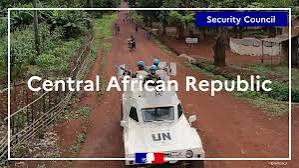
The Central African Republic is taking a new step towards preventing conflicts between herders and farmers, with the gradual deployment of specialised units tasked with securing transhumance corridors, supported logistically and operationally by the United Nations Multidimensional Integrated Stabilization Mission in the Central African Republic (MINUSCA).
The Special Representative of the UN Secretary-General and Head of MINUSCA, Valentine Rugwabiza, on Friday handed over four all-terrain vehicles and an initial batch of motorcycles to the Minister of the Interior and Public Security, Bienvenue Zokoué, for the national police and gendarmerie.
The equipment is intended to strengthen the security forces’ presence along routes used by herds and improve their ability to respond to threats against herders, farmers and their property.
The initiative marks the implementation of recommendations made at the High-Level National Conference on Peaceful and Prosperous Transhumance, held in Bangui on May 13, 2024.
The conference called, among other things, for stronger security along pastoral corridors, the prevention of farmer-herder conflicts, the development of livestock infrastructure and cross-border cooperation.
Since the conference, MINUSCA and UN agencies have been supporting the Central African authorities in developing a national transhumance strategy, updating maps of the corridors and strengthening community-based mechanisms for preventing tensions.
Their work has also included raising awareness of peaceful coexistence and establishing the first joint border post in Bembéré.
“Security is only one aspect of peaceful and prosperous transhumance,” Valentine Rugwabiza stressed, emphasising the need for cooperation between security forces, administrative authorities, livestock services and local bodies responsible for transhumance.
The aim is to gradually equip the internal security forces with 600 motorcycles to improve their mobility and deployment along pastoral corridors.
The equipment will be supplied in phases, according to priorities defined jointly with the Central African authorities.
Starting in December 2026, three sites will be set up to accommodate the first specialised units. The designated police officers and gendarmes will receive training from MINUSCA’s Police Component, along with logistical support for one year.
Their operations will be required to comply with UN standards on human rights, integrity and discipline.
Minister Bienvenue Zokoué welcomed the support and pledged to make these units instruments for preventing, responding to and managing tensions related to transhumance.
Through this initiative, Bangui aims to strengthen security oversight of an economic and pastoral activity whose poor organisation can fuel tensions between communities.
The objective is to turn transhumance corridors into safer routes that also foster peaceful coexistence.
TE/Sf/lb/gik/APA