



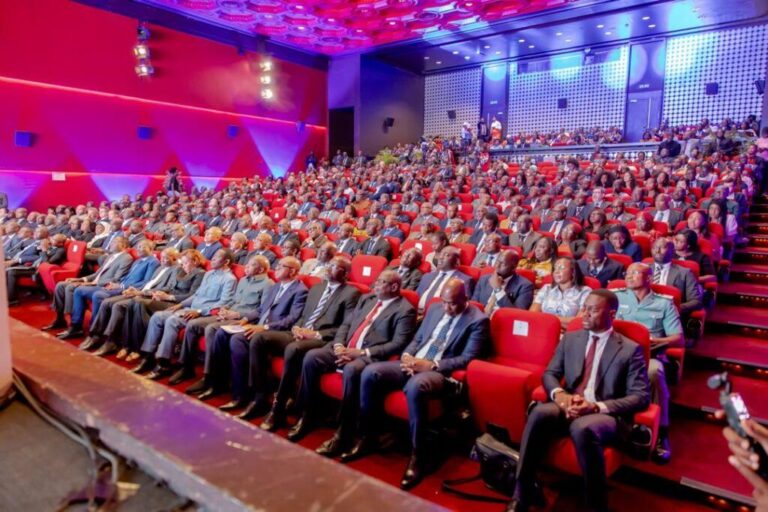
During the official presentation of the Integrated Mineral Resources and Energy Policy (PIRME) in Abidjan on Monday, November 9, 2026, the Director General of Hydrocarbons, Bienvenu Esse, provided an overview of the national energy sector that reflects highly ambitious goals.
Bolstered by massive reserves and major structural projects, Côte d’Ivoire is positioning itself to become a key energy hub in West Africa and across the continent.
“We have a robust foundation,” the Director General affirmed.
The Ivorian subsoil holds nearly 5.3 billion barrels of oil and approximately 5 trillion cubic feet of natural gas. The program’s objective is clear: to increase the production of energy in all its forms to provide sustainable support for both the national economy and that of the sub-region.
Regarding the daily supply of natural gas, Côte d’Ivoire currently produces 320 million cubic feet per day (Mcf/d). With the development of the Calao oil field, the country aims to reach 685 million cubic feet per day by 2030 and 1 billion by 2040.
As for daily oil production, the Director General of Hydrocarbons, Bienvenu Esse, stated that while Côte d’Ivoire is currently producing 80,000 barrels per day in 2026, it targets 231,000 barrels per day by 2030, rising to 500,000 by 2040.
To support this extractive boom, the Ivorian government plans to construct a second oil refinery – operated by the Ivorian
Refining Company (SIR) – in San-Pedro (in the southwest), with a capacity of 6.1 million tonnes per year. The electricity component of the PIRME (Integrated Master Plan for Resources, Minerals, and Energy) is equally significant. Côte d’Ivoire’s current installed power capacity of 3,360 MW is set to receive massive investment, reaching 5,128 MW by 2030 and 11,414 MW by 2040 – a 3.4-fold increase in production capacity.
In total, the ministry has identified 49 projects requiring an overall budget of 5,269 billion CFA francs. A major shift lies in the ecological transition: nearly half of the energy mix by 2040 will come from renewable sources.
While green energy currently accounts for 30% of capacity, the country aims for 45% by 2030 and 49% of the energy mix by 2040.
The breakdown of priority projects includes thermal energy – comprising 9 supporting projects totalling 3,785 MW – alongside renewable energy initiatives.
Renewable energy projects include 30 solar installations (2,841 MW), 4 hydroelectric power plants (710 MW), and 3 biomass units (204 MW), all supported by 3 major energy storage facilities with a combined capacity of 500 MW.
The Ivorian government’s 2040 vision extends beyond the export of raw materials. The PIRME incorporates the development of full-scale mineral processing and petrochemical industries.
To streamline transport and logistics, the government is planning large-scale investments in the country’s southwest, including the construction of a mineral port in San-Pedro and the development of 474 km of railway lines dedicated exclusively to the transport of minerals.
AP/Sf/fss/as/APA