





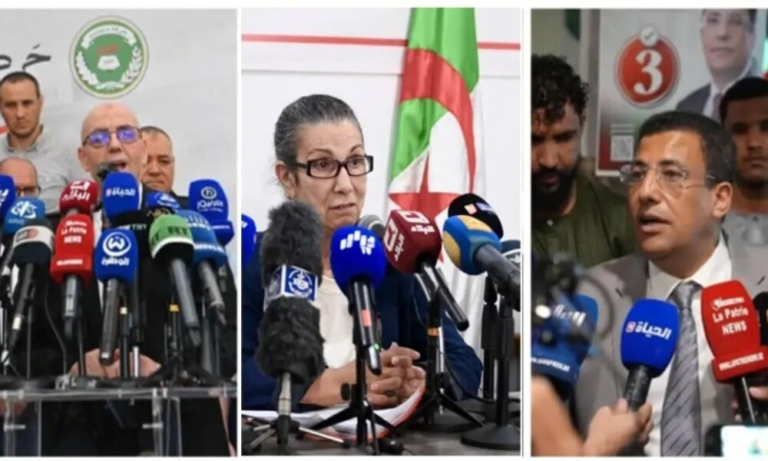
With less than three weeks to go before the legislative elections scheduled for July 2, political parties across Algeria are intensifying their campaign activities nationwide against a backdrop of rising social concerns and lingering uncertainty over voter turnout.
On the fifth day of the official electoral campaign, the main parties competing in the legislative race focused their core messages on purchasing power, employment, education, and institutional reform. In Algiers, the Socialist Forces Front (FFS) presented an electoral platform deeply centered on social issues, introducing proposals to raise the minimum wage, increase public sector salaries, and implement support measures for students, job seekers, and vulnerable groups. The party also called for price controls on essential goods in order to ease the immediate impact of inflation on average households.
Meanwhile, in Tlemcen, the leader of the Movement of Society for Peace (MSP), Abdelaali Hassani Cherif, focused his message on voter abstention, which has emerged as a key concern in the current campaign. Several political leaders express fear over a potentially low turnout, noting it is a recurring trend in past elections that is often interpreted as a clear sign of public mistrust in representative institutions. Other parties have sought to distinguish themselves through sector-specific proposals during their tours. The National Rally for Democracy (RND) has emphasized education system reform, while the El Bina Movement has highlighted institutional stability alongside greater participation of women in public life. In a similar vein, the Workers’ Party (PT) and Sawt Echaab have both called for stronger citizen engagement in the political process.
Despite the diversity of their platforms, many parties are converging on similar themes, particularly the protection of purchasing power, the fight against social hardship, and the improvement of public services. This ideological convergence reflects the immense weight of economic concerns in a country still facing persistent pressure on household incomes, despite revenues generated from hydrocarbons. For several observers, however, the main challenge of this campaign may lie less in policy promises than in the actual ability of parties to persuade voters to turn out on election day. Repeated appeals by political leaders to encourage participation highlight deep concerns over expected turnout levels in a vote whose political legitimacy will largely depend on voter participation.
MK/AK/Sf/lb/abj/APA