



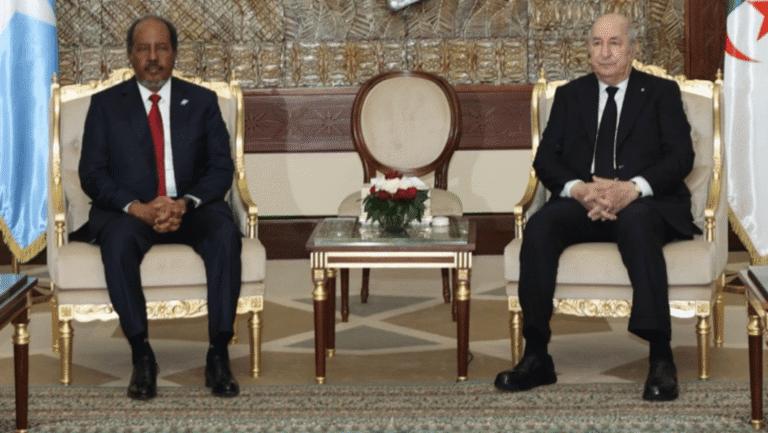
A visit by Somali President Hassan Sheikh Mohamud to Algiers culminated in the signing of eight cooperation agreements, signaling Algeria’s continued, yet largely symbolic, ambition to enhance its influence on the African continent.
By hosting his Somali counterpart, President Abdelmadjid Tebboune aimed to underscore Algeria’s diplomatic re-engagement on the African stage. The official visit, characterized by strong diplomatic symbolism and a major signing ceremony, is part of Algiers’ broader strategy to consolidate its continental presence.
The eight signed agreements span crucial sectors including energy, agriculture, maritime fishing, and higher education. Concrete results of the collaboration will be seen starting in 2026, when 110 Somali students are scheduled to be hosted at Algerian universities as part of an academic cooperation program running through 2029.
“We are satisfied with the results of our consultations,” declared President Tebboune, who also mentioned a future expansion of cooperation into the military and police sectors.
On the political front, Algiers and Mogadishu affirmed their alignment on major regional issues: Palestine: They reaffirmed their joint support for the creation of a Palestinian state within the 1967 borders. Sovereignty: They reiterated their commitment to the sovereignty of Arab countries. Regional Crises: Discussions included the Libyan and Sudanese crises, with Algeria sharply denouncing “foreign interference” and advocating for inclusive political solutions.
Despite these diplomatic signals and the substantial cooperation agreements, the actual economic and political impact of Algerian action in Africa remains limited. The country’s strong dependence on hydrocarbons restricts its economic flexibility and hinders its ability to translate its pan-African rhetoric into concrete, large-scale projects.
While Algeria publicly aspires to position itself as a strategic bridge between the Arab world and Africa, its current trade volume with the continent remains low, amounting to less than 3 percent of its total trade. In contrast, regional competitors like Morocco, Nigeria, and Egypt are aggressively forging numerous economic partnerships and driving major regional initiatives.
The government has been actively trying to reposition the country as a key player since the 2022 Arab summit in Algiers. However, without structural reforms and a coherent investment strategy backing its diplomatic efforts, this ambition remains, for the time being, more symbolic than practically influential.
MK/te/fss/abj/APA