



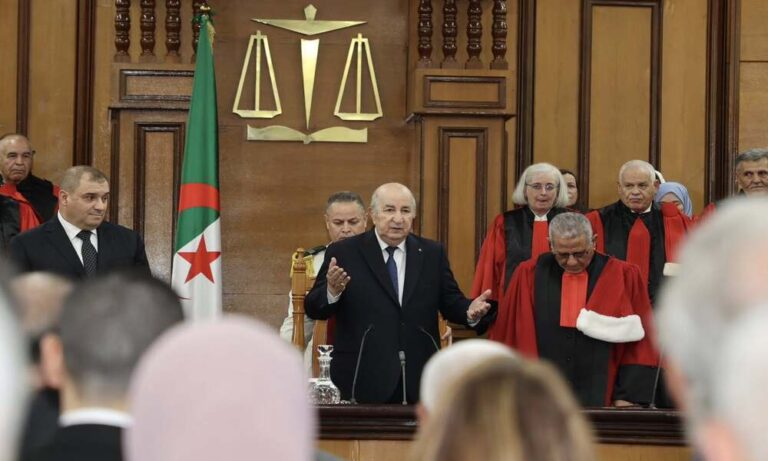
During the opening of the judicial year, Algerian President Abdelmadjid Tebboune reiterated his commitment to establishing the judiciary as a pillar of the rule of law.
However, analysts argue that the presidential address, while filled with rhetoric of independence and integrity, ultimately reflected a desire for continued political control over the judiciary rather than genuine institutional autonomy.
Speaking at the Supreme Court, President Tebboune claimed a “silent revolution” had been underway since 2019, asserting that reforms have restored citizen confidence, improved public morality, and strengthened national sovereignty. This seemingly positive language, often repeated since the Hirak movement, fails to mask the persistence of a judicial system widely viewed as subservient to the executive branch.
Despite the official focus on the “fight against corruption” and the “rule of law,” high-profile prosecutions—particularly those targeting political opponents, journalists, and activists—continue to illustrate the structural dependence of the prosecutor’s office on the presidency. Trials based on charges like “undermining national unity” or “spreading false news” suggest the political utility of the law takes precedence over the purported independence of judges.
Tebboune also promoted the new Code of Criminal Procedure, claiming it guarantees fair trials and facilitates investment. In practice, however, critics observe that successive legislative revisions have primarily expanded the state’s room for action in security and cybercrime cases, often to the detriment of civil liberties. For litigants, the “rule of law” remains an institutional promise largely divorced from concrete reality.
Furthermore, while the President welcomed the transition to “digital justice” as a guarantee of transparency, observers note that technical modernization does not address the fundamental issue of centralized decision-making power. “Digitization” cannot compensate for the lack of checks and balances, particularly when the composition of the High Council of the Judiciary remains under presidential influence.
Looking ahead, the Head of State announced the upcoming promulgation of the new statute of the judiciary, which is presented as a tool to protect judges. Yet, in a system where appointments, transfers, and sanctions are ultimately decided by the presidency, magistrates continue to operate under hierarchical pressure. The political control over the judiciary, a legacy of the Bouteflika era, remains largely intact despite repeated promises of a “break” with the past.
By insisting that justice is the “pillar of national sovereignty,” President Tebboune appears focused on strengthening the legitimacy of a regime grappling with social distrust and economic turmoil. The recurrent themes of “moralization” and “transparency” serve less to fundamentally reform the justice system than to justify the political status quo. At a time when Algerian civil society demands greater freedoms and a clear separation of powers, the judiciary continues to function as a political lever rather than a fully independent institution.
MK/Sf/fss/abj/APA