





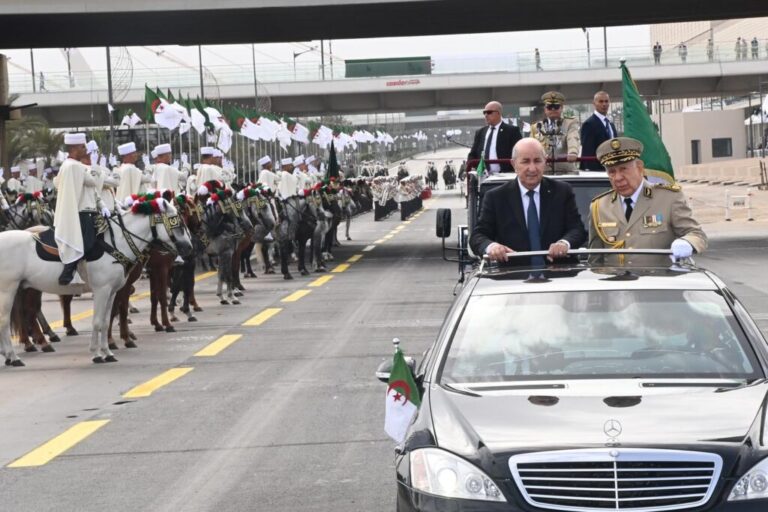
One year after taking the oath for his second term, Abdelmadjid Tebboune is touting an Algeria moving toward food self-sufficiency and major industrial projects. Yet behind the announcements, structural vulnerabilities persist.
Twelve months ago, President Tebboune raised his right hand at the Palais des Nations, pledging a “victorious Algeria.”
Today, the head of state presents a record he wants seen as significant: self-sufficiency in durum wheat, social benefits increases, infrastructure projects, and large-scale mining initiatives. A closer look, however, reveals an economy still heavily reliant on hydrocarbons, public finances under pressure, and reforms whose depth remains debatable.
The 2025 harvest allowed Algeria to achieve durum wheat self-sufficiency, a long-standing goal. But this milestone depends on favourable climatic conditions and massive budgetary efforts for irrigation in a country prone to drought. Promises to halt barley and corn imports by 2026 appear ambitious, as livestock farming and agro-industry remain dependent on imported products.
The government highlights the revision of teachers’ and healthcare workers’ status, increases in travel allowances (€750 for adults, €300 for children), and the extension of maternity leave to 150 days. These measures, framed as historic advances, aim to restore trust between the state and citizens. Yet their fiscal impact raises questions amid persistent inflation and structural unemployment, particularly among young graduates.
Housing remains a central political lever. The launch of the Aadl 3 program and distribution of hundreds of thousands of homes are promoted as social victories. However, chronic delays and often poor construction quality underline that access to housing remains a sensitive issue.
On infrastructure, the extension of the railway network to the south and the commissioning of desalination plants mark progress, but timelines and long-term maintenance remain concerns.
Tebboune is betting on three major mining and industrial projects: the Ghar Djebilet iron mine, the Bled El Hadba phosphate complex, and the Oued Amizour zinc and lead project. Positioned as pillars of economic diversification, they require massive investment and foreign partnerships in a business climate that remains challenging. Hydrocarbons continue to dominate, accounting for over 90 percent of export revenues.
The president aims to raise Algeria’s GDP to $400 billion by 2027. But this target seems disconnected from reality, in a context of volatile growth tied to gas and oil prices. The creation of a Ministry of Hydrocarbons and Mines, along with a department dedicated to renewable energy, signals a desire to rationalise the sector while highlighting the difficulty of moving away from a rentier economic model.
MK/lb/as/APA