





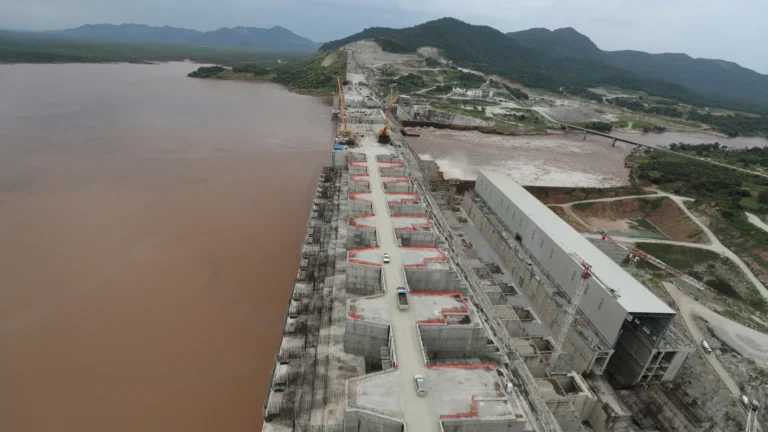
As Addis Ababa inaugurates its massive hydroelectric dam, Egypt is multiplying legal, diplomatic, and technical initiatives to defend what it regards as a vital existential right – its unfettered access to resources from the River Nile.
Ethiopia’s official launch of the Grand Ethiopian Renaissance Dam (GERD), with a capacity of 5,000 MW and able to hold up to 74 billion cubic meters of water from the Blue Nile, has resounded alarm bells in Cairo.
Dependent on the river for 97 percent of its drinking water, agriculture and industry, Egypt has denounced what President Abdel Fattah al-Sisi calls an “existential threat.”
On the day of the inauguration, Foreign Minister Badr Abdelatty referred the matter to the president of the UN Security Council, describing Ethiopia’s move as a “violation of international law.”
Experts note that Egypt holds a first “legal card”: invoking the historic 1929 and 1959 treaties as well as principles of international law on the equitable use of transboundary rivers to demand a binding agreement on the filling and operation of the GERD. “The inauguration without consensus is a unilateral act that breaches the 2015 Declaration of Principles,” said Mohamed Mahmoud Mahran, professor of international law.
The second card is diplomatic.
Cairo is rallying the African Union, the United Nations, the Arab League and major powers to exert pressure on Addis Ababa, arguing that reduced Nile flows could jeopardise the food security of more than 100 million Egyptians. “Since the beginning, Ethiopia has moved forward unilaterally in stages,” noted Abbas Sharaky, a Nile resources expert. In his view, bringing the case before the United Nations remains essential to counter “the fait accompli.”
At the same time, Egypt is working to unite downstream states against Ethiopia. Recent overtures to Eritrea and Somalia, along with ongoing dialogue with Sudan, aim to build a common front. “A unified position would greatly strengthen Cairo’s hand,” Sharaky said.
Domestically, the government is rolling out adaptation measures: desalination and wastewater treatment plants, upgrades to irrigation networks, and nationwide conservation campaigns.
For water expert Nader Nour Eddine, such measures are critical in the face of a chronic shortfall. Egypt receives 55.5 billion cubic meters of water against needs exceeding 90 billion, with per capita availability having fallen below 500 m³ per year—well under the UN’s water poverty threshold.
Finally, Cairo is betting on international communication, framing the dispute as a question of the fundamental right to water rather than a mere political row between two countries. “By presenting data and impact studies, Egypt places Addis Ababa under the world’s scrutiny,” Sharaky concluded.
In the battle over the Nile, Egypt is combining law, diplomacy, regional alliances and technical resilience to safeguard its water future.
MK/ac/lb/as/APA