



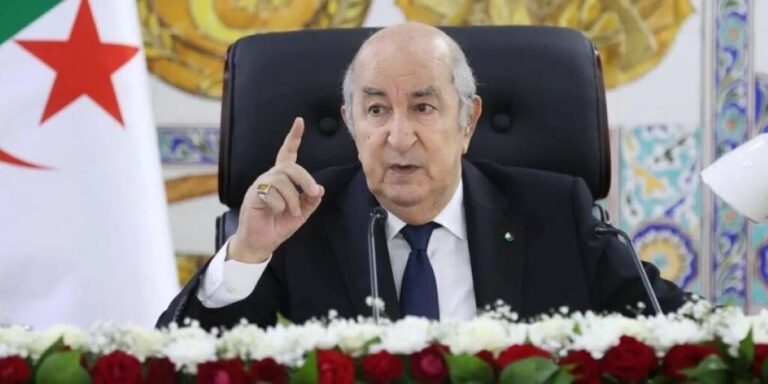
At the 39th African Union Summit in Addis Ababa, President Abdelmadjid Tebboune denounced “foreign interference” as a driver of instability, while calling for African solutions to the continent’s crises in a speech consistent with Algiers’ longstanding diplomatic doctrine.
The address, delivered on his behalf by Prime Minister Sifi Ghrieb during the session devoted to the report of the Peace and Security Council (PSC), came amid a continental landscape marked by multiplying flashpoints. Referring to “geopolitical complexities” and “heightened security pressures,” Tebboune urged collective action to safeguard peace and stability across Africa.
He commended Egypt’s presidency of the PSC and noted that the report was presented in a “delicate context” generating “growing concern” for the continent’s development prospects.
On major security dossiers, the Algerian president reiterated well-established positions. Regarding eastern Democratic Republic of Congo, he reaffirmed Algeria’s “full support” for the sovereignty and territorial integrity of Kinshasa, calling for an immediate cessation of hostilities and stronger African-led mediation efforts.
In the Sahel, Tebboune argued that “traditional approaches are no longer sufficient,” advocating for a comprehensive strategy linking security and development, with particular emphasis on youth employment and addressing the socio-economic roots of violent extremism. On Libya, he backed the inter-Libyan political process, stressing the need for “free and transparent” elections and the withdrawal of foreign forces and mercenaries.
The head of state also expressed “deep dismay” over the war in Sudan, urging an immediate ceasefire and inclusive national dialogue, while supporting African-led initiatives. In the Horn of Africa, he underscored respect for sovereignty and the peaceful settlement of disputes. Concerning the Western Sahara conflict, he reaffirmed Algeria’s support for UN-led efforts toward a “just, lasting and mutually acceptable” political solution in line with Security Council resolutions.
Denunciation of “illegitimate foreign interference” formed the central thread of the speech. For Tebboune, such external interventions are the “primary factors” of instability and obstacles to African democratic processes. This sovereigntist stance, a constant in Algerian diplomacy, was presented as a call for continental unity.
MK/ak/lb/as/APA