



Closer ties between authorities in eastern Libya and Niger’s government have taken a new step with the announced signing of a strategic cooperation protocol, amid shifting security dynamics in the Sahel and North Africa.
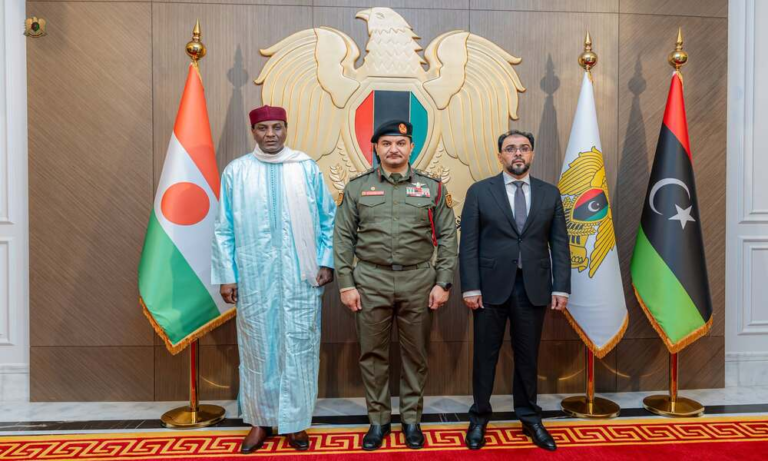
Saddam Haftar, a military official and son of Field Marshal Khalifa Haftar, received Nigerien Prime Minister Ali Mahaman Lamine Zeine in Benghazi, accompanied by a high-level delegation. The meeting was also attended by Oussama Hamad, head of the eastern Libyan government.
The meeting, announced in a post on Saddam Haftar’s Facebook account, is part of a broader rapprochement between the authorities in eastern Libya and Niger, against a backdrop of mounting security challenges in the region.
During the meeting, Saddam Haftar conveyed to the Nigerien prime minister the greetings of the commander-in-chief of the Libyan National Army, Field Marshal Khalifa Haftar, to Niger’s president, General Abdourahamane Tiani. He also highlighted the countries’ longstanding historical ties and their shared interests in the face of political and security changes affecting the Sahel-Saharan region.
Beyond diplomatic statements, discussions focused mainly on cross-border security, including efforts to combat terrorist networks, organised crime and smuggling. For the authorities in eastern Libya, instability in border areas poses a direct threat not only to national security but also to that of neighbouring countries. Saddam Haftar advocated a regional approach based on operational coordination, respect for state sovereignty and the preservation of national choices.
The meeting also saw the announcement of a strategic cooperation protocol between Libya and Niger. Presented as a further step towards closer bilateral ties, the agreement is expected to provide a more structured framework for consultations and translate political commitments into operational programmes. However, the announcement provided no specific details about its content, the sectors covered or the implementation timetable.
The initiative comes amid shifting security alliances in the Sahel, where Niger, Mali and Burkina Faso have stepped up cooperation within the Alliance of Sahel States (AES). The geographical proximity of southern Libya to the Sahel gives these developments particular significance for the authorities in Benghazi, which are seeking to strengthen their diplomatic presence and ties with regional players.
For Khalifa Haftar’s camp, closer relations with Niamey therefore offer another means of strengthening its position in African affairs. It remains to be seen whether the announced protocol will lead to concrete and lasting cooperation, particularly on border security, in a region where declarations of security solidarity regularly encounter difficulties in coordination between states.
MK/AK/Sf/lb/as/APA