



The tightening of migration controls in Morocco, Mauritania, and Senegal is shifting the departure points for West African migrants attempting to reach Europe further south.
The Gambia is emerging as a key player in this reconfiguration of routes toward the Canary Islands, while rescue operations and shipwrecks highlight the dangers inherent in these crossings, as observed by APA.
According to data from the International Organization for Migration (IOM) published on October 14, 2026, the number of migrants from West Africa arriving in Europe fell by 59% in the first half of 2026 compared to the same period in 2025, totaling 4,566 individuals.
This decline is particularly notable among nationals from Mali, Senegal, Guinea, and The Gambia.
This drop in arrivals is accompanied by a shift in routes. West African nationals now account for 21.9% of arrivals along the Western Mediterranean route, up from 15.6% previously. On the Atlantic route toward the Canary Islands, arrivals fell by 62% between 2024 and 2025; however, the number of deaths and disappearances rose from 1,172 to 1,215.
The IOM notes that stricter migration controls in Morocco, Mauritania, and Senegal are pushing departure points further south.
As a result, some crossings have extended by approximately 750 kilometres – reaching a total distance of about 2,200 kilometres – thereby increasing the risks to passengers, including mechanical failures, shortages of food and water, and shipwrecks.
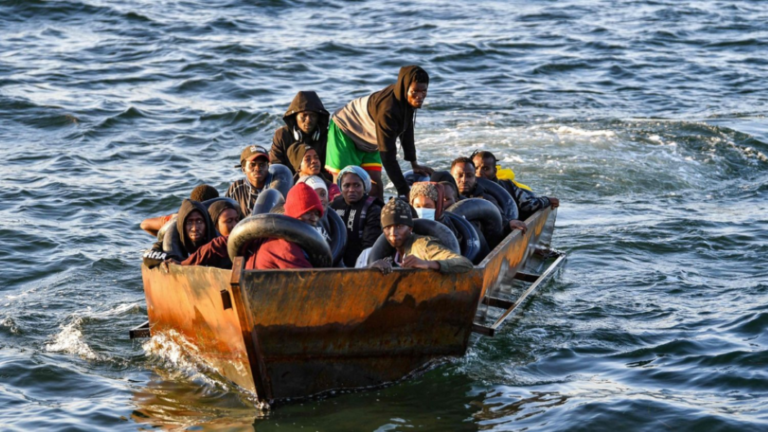
The Gambia serves as an example of this trend. On September 3, 2026, a pirogue that had departed from the Gambian coast was rescued south of the Canary Islands after drifting for 26 to 27 days. According to the platform “Sur les traces du migrant” (“Tracing the Migrant”), 128 people had initially boarded, but only 45 passengers survived. More than 80 individuals, including an infant, perished during the crossing.
Departures from The Gambia also involve nationals from several other countries in the sub-region. On May 31, 2026, the Mauritanian coast guard intercepted a vessel arriving from The Gambia carrying 223 people attempting irregular migration. The passengers included nationals from Senegal, The Gambia, Guinea, Burkina Faso, Nigeria, and Ivory Coast, among others.
On October 20, 171 migrants were also rescued after their pirogue ran aground at Pilote Bar, in the commune of Gandiol, northern Senegal.
The group consisted of 114 Gambians, 37 Senegalese, and one Guinean national. Preliminary investigation findings indicated that the vessel had departed from the Gambian coast on October 15, bound for Spain.
The shifting of migration routes is accompanied by the activities of suspected migrant-smuggling networks operating across several countries. In a case brought to light on October 1, a transnational network spanning Senegal, The Gambia, and Guinea-Bissau was dismantled.
According to an investigation by the National Division for Combating Migrant Smuggling and Related Practices, approximately 190 individuals had been identified as intending to make the clandestine crossing to the Canary Islands.
Nearly 140 of them were reportedly gathered in an apartment in Bara, The Gambia, ahead of a planned transfer to Senegal.
The risks are not limited to vessels departing from The Gambia. On January 2, 2026, a shipwreck off the Gambian coast resulted in at least seven deaths.
Ninety-six would-be migrants were rescued by the Gambian navy, while other passengers remained missing. The vessel had departed from the village of Jinack, in the North Bank region,
embarking on an irregular journey toward Europe.
These events demonstrate that a decline in arrivals in Europe does not necessarily mean a reduction in the dangers encountered along migration routes. The shifting of departure points, the increasing distances, and the precarious nature of the vessels continue to expose migrants to major risks.
The regional response faces a dual challenge: strengthening the fight against smuggling networks while protecting people on the move.
IOM Director General Amy Pope has called for greater cooperation between states and the development of safe migration pathways, noting that no single country can resolve this situation on its own.
However, mobility in West Africa is not limited to departures for Europe. According to IOM data, more than 77% of the 11.3 million migrants living in West and Central Africa originate from within that same region.
The search for employment, economic exchange, family ties, and environmental pressures all drive these movements.
The challenge for states, therefore, remains to reconcile border management and regional free movement with the protection of migrants and the creation of sustainable economic opportunities.
AC/Sf/fss/as/APA