





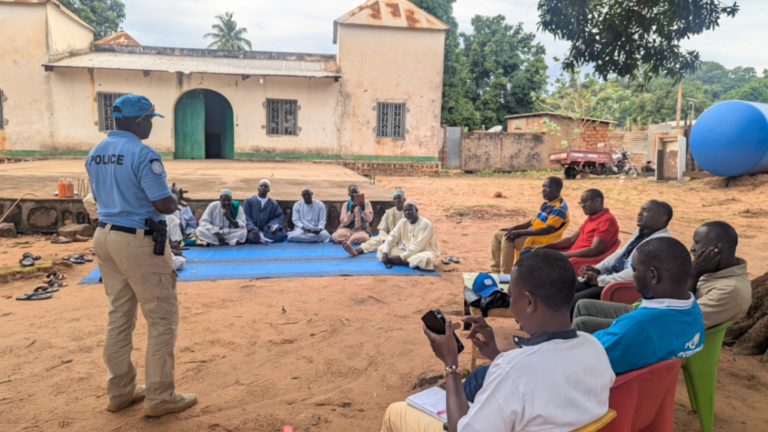
The United Nations Multidimensional Integrated Stabilization Mission in the Central African Republic (MINUSCA) has strengthened its dialogue with religious leaders in Ndele, in the Bamingui-Bangoran prefecture, to support efforts to consolidate peace, promote social cohesion, and protect civilians.
On August 14, 19, and 20, MINUSCA met with 43 religious leaders, including 32 Christians and 11 Muslims.
These meetings aimed to strengthen collaboration with these influential community actors, who are particularly committed to preventing tensions and promoting peaceful coexistence.
The religious leaders welcomed this initiative, recalling their role in preserving peace during the various crises that have affected the region.
“We are on the right track towards peace and social cohesion,” they said. “This is an achievement that must be nurtured every day,” declared Pierre Makossa Bangui, pastor of the UFEB Church in Ndele, calling for a focus on forgiveness and openness between communities.
In mosques as well as churches, messages promoting peaceful coexistence are regularly shared during sermons. For religious leaders, this awareness campaign is essential to preserving the gains made in recent years.
Abdel Affis Soumaine, Imam of the central mosque in Ndele and President of the Platform of Religious Denominations, believes that community mobilisation must continue.
“Raising awareness helps people understand that peace is priceless,” he emphasised.
A Peace to Consolidate
The security situation has improved in Ndele in recent years, but local stakeholders remain cautious. They consider peace an ongoing process that requires constant effort, particularly to strengthen cohesion between communities.
“Much remains to be done, as everything is not perfect,” noted Yacinthe Kalengona, Vicar of the Sainte-Marie parish, advocating for the continuation of initiatives promoting social cohesion.
Religious leaders also mentioned the material and logistical constraints that limit their ability to act on the ground.
For MINUSCA, these discussions not only allowed them to better explain their mandate, but also to directly gather the concerns of the communities and identify avenues for collaboration.
Wilfried Relwendé Sawadogo, head of the MINUSCA office in Ndele, expressed the mission’s commitment to translating this dialogue into concrete actions.
“We hope to implement concrete projects to work together to strengthen state authority, improve social cohesion, and better protect civilian populations,” he stated.
Through this partnership with religious denominations, MINUSCA intends to strengthen local conflict prevention mechanisms and contribute to the consolidation of lasting peace in Bamingui-Bangoran.
TE/Sf/fss/gik/APA