





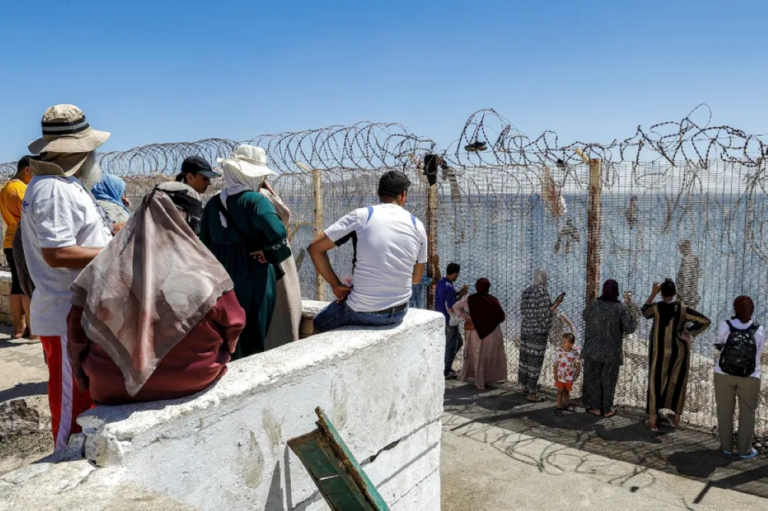
A transnational digital campaign across six platforms allegedly spread misinformation and logistical instructions ahead of mass border crossing attempts into Ceuta, according to a Spanish social media intelligence study.
The cross-border digital operation contributed to directing migrants toward Fnideq and the Ceuta border ahead of crossing attempts recorded between July 30 and August 1, asserts a study completed Sunday by José María Gil Garre, a Spanish open-source intelligence and security analyst.
The 49-day investigation, conducted from June 15 to August 2, examined content published across WhatsApp, Facebook, TikTok, Instagram, Discord, and X. According to its author, the mobilisation was largely fueled by a distorted interpretation of a July 8 ruling by the Spanish Supreme Court, which was framed on social media as a legal opening of the border preventing immediate deportations.
Starting in mid-July, posts increasingly featured transport guidelines, route options, and meeting locations. Travel movements from several Moroccan cities—including Casablanca, Rabat, Fez, Marrakech, Tangier, Tetouan, and Al Hoceima—as well as entries from Algeria into Morocco, were frequently referenced in the monitored groups, with Fnideq serving as the primary hub.
The study estimates the campaign’s potential reach at between one and five million impressions. Monitored Facebook communities comprised over 250,000 members, while specific TikTok videos garnered millions of views. The account Haraga El Ghorba reportedly accumulated nearly seven million total views on certain video clips.
Each platform fulfilled a specific role in the scheme. TikTok and Instagram drove audiovisual amplification, Facebook hosted maps and practical information, and WhatsApp was used to share real-time schedules, meeting points, police check locations, and route changes. X primarily served to internationalise the political interpretation of events.
According to the report, two WhatsApp groups administered from phone numbers with the Algerian country code (+213) played a key role in coordination. The first, named “Assault for the Ceuta Crossing,” was detected on July 28. The second began promoting Melilla as an alternative destination after security controls around Ceuta were tightened. However, the study notes that these findings alone are insufficient to identify the organisers or prove state involvement.
The study concludes that early warning signs had emerged weeks prior to the crossing attempts, including a surge in identical messages, the reactivation of legacy group chats, the sharing of detailed maps, the creation of ephemeral accounts, and the gradual rollout of precise schedules. It describes a decentralised network of broadcasters, coordinators, facilitators, and recipients capable of swiftly adapting instructions to counter measures taken by authorities.
MK/AK/Sf/lb/as/APA