





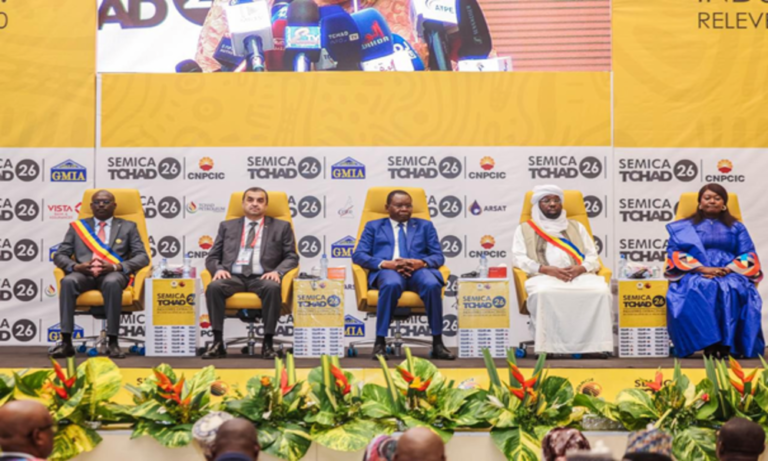
The first edition of the International Exhibition of Mines, Quarries and Hydrocarbons of Chad (SEMICA) was officially opened on Tuesday in N’Djamena under the chairmanship of Prime Minister Allah Maye Halina.
Running until January 23, 2026, SEMICA brings together public authorities, private-sector operators and international partners to discuss the strategic challenges facing the extractive sector.
Held under the theme “Extractive Industries: Meeting the Challenges of Vision 2030,” the event aligns with the Chadian government’s policy orientation to harness natural resources as a driver of sovereignty, economic transformation and social equity, in line with the national development plan Chad Connection 2030.
Opening the proceedings, Minister of Petroleum, Mines and Geology Ndolenodji Alixe Naimbaye stressed the need for national control over resources.
“Sovereignty over our mines, quarries and hydrocarbons is not a slogan, but a political imperative and a prerequisite for sustainable development,” she said.
Chad’s subsoil holds a diverse range of mineral resources, including artisanally mined gold, antimony, uranium indicators, natron, limestone, clay, as well as quartz, salt, gypsum and traces of strategic metals. However, the sector remains largely dominated by artisanal mining, with limited industrial development.
Oil, meanwhile, continues to be the backbone of the Chadian economy and the country’s main source of export revenue. Commercially exploited since 2003, production is concentrated mainly in the Doba basins and transported via the Chad–Cameroon pipeline to the port of Kribi, while the Djermaya refinery supplies the domestic market.
According to the authorities, meeting the challenges of Vision 2030 requires a break with poorly integrated extractive models in order to generate greater local value added, develop national value chains, and promote the transfer of skills and technologies.
As part of this drive, the government has launched legal and institutional reforms aimed at strengthening state sovereignty, providing a stable framework for investors, promoting balanced partnerships and ensuring tangible economic benefits for producing regions.
Prime Minister Allah Maye Halina urged participants to put forward concrete recommendations, particularly on diversifying mineral exploration and identifying strategic minerals. The opening ceremony was attended by several African ministers responsible for energy and mining, underscoring the regional interest in SEMICA and Chad’s extractive ambitions.
RNK/sf/lb/as/APA