





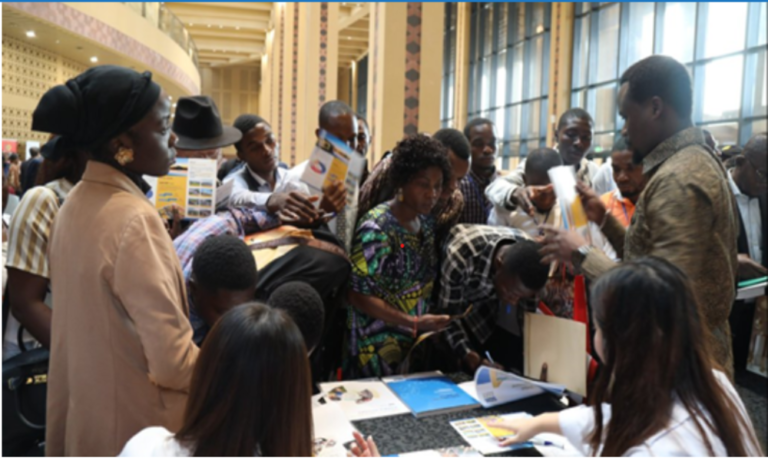
China and the Democratic Republic of Congo have reaffirmed their shared commitment to making professional and technical training a driver for youth employment. This pledge was made during the launch of the Sino-Congolese Conference on Professional and Technical Training, held on Monday, December 22, in Kinshasa.
The Sino-Congolese Conference on Professional and Technical Training opened at the Central African Countries Cultural and Artistic Center (CCAPAC), attended by over a thousand participants, most of whom were young people.
The meeting aimed to strengthen lasting partnerships and promote innovative approaches to adapt the skills of Congolese youth to the real needs of the job market.
According to the Congolese Minister of Vocational Training, Marc Ekila, the conference was resolutely focused on action. He praised the Chinese example, which is founded on strong strategic choices, notably massive investment in training, work discipline, technology, and industrialization.
The Chinese ambassador to the DRC, Zhao Bin, emphasised that the goal of this cooperation is to meet local needs through the establishment of a skills improvement platform, enabling the DRC to train its own talent and strengthen its capacity for national development.
In infrastructure, Sino-Congolese cooperation is materialised through specialised training in the use of construction machinery, quality control of engineering works, and the operation and maintenance of electrical grids. These initiatives allow local personnel to master the key technologies needed for structural projects such as roads, bridges, and power networks.
Concerning the valorisation of natural resources, China is concentrating its efforts on competitive sectors like mining, through training focused on safety standards, exploration techniques, and environmental protection, with the goal of creating sustainable development for the sector.
The social component is not overlooked, with targeted training in the fields of agriculture, health, and information technology, contributing to improved employability and quality of life for the population. Concurrently, Chinese experts are conducting agricultural technique outreach activities in the N’sele commune, east of Kinshasa.
Present at the conference, Sino-Congolaise des Mines (SICOMINES) showcased its achievements and the employment opportunities offered through its activities. The mining joint venture reported selecting 100 top Congolese employees annually, training approximately 4,000 people, and offering aid to nearly 2,000 beneficiaries, while generating at least 7,000 local jobs.
To date, SICOMINES has created 7,832 local jobs, including 2,829 within the company and 5,003 in sub-contracting firms. Furthermore, 2,147 mining professional talents have been trained in several technical specialties. The company also dedicates over one million US dollars annually to local social projects.
Thanks to SICOMINES’ support for the vocational training sector, the DRC can strengthen cooperation between schools and companies, thus offering young people quality expertise and increased prospects for entrepreneurship.
Sino-Congolese cooperation covers several key development sectors, including infrastructure, mining, agriculture, and vocational training. The DRC remains one of the primary destinations for Chinese investment in Africa, a dynamic that illustrates the solidity and continuity of the strategic partnership between the two countries.
DM/sf/lb/as/APA