





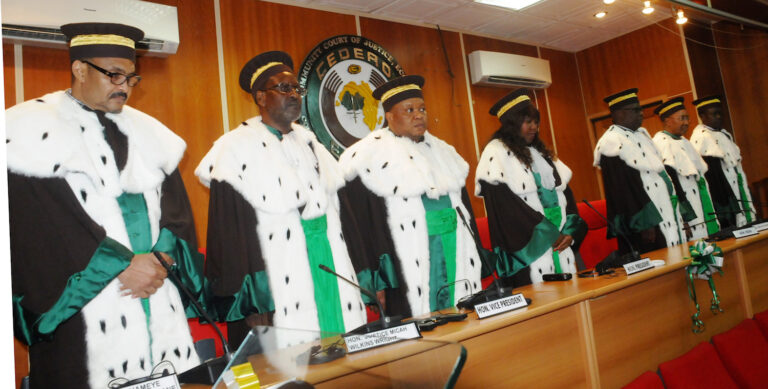
The Court of Justice of the Economic Community of West African States (ECOWAS) has accused Nigeria of refusing to comply with its decisions, lamenting that 80 per cent of its judgments could not be enforced.
The President of the regional court, Justice Ricardo Goncalves, made the disclosure when he led a delegation of judges from the court on a courtesy visit to the Chief Justice of Nigeria (CJN), Justice Kudirat Kekere-Ekun.
Justice Goncalves said that the visit was to solicit the support of the CJN to ensure the enforcement of judgments of the ECOWAS Court in Nigeria.
He blamed lack of political will for the fact that several verdicts of the court remained unexecuted.
The ECOWAS Court President urged Nigeria to lead by example, insisting that “if Nigeria enforces the court’s judgments, other member states will follow suit.”
Responding, the Chief Justice of Nigeria commended the regional court for what she described as its “landmark and impressive judgments on the enforcement of fundamental human rights in the sub-region.”
While acknowledging the importance of enforcing the court’s judgments, the CJN implored the delegation to come up with guidelines that will facilitate the implementation of verdicts by member states.
She stressed that enforcing the court’s decisions lies mainly with the executive arm of government.
She therefore advised the court to use the opportunity provided by its Bilateral Meeting on the Status of the Judgments of the Community Court of Justice of ECOWAS to develop a uniform procedure for the enforcement of the court’s decisions.
Furthermore, the CJN enjoined the judges of the court to consult widely with stakeholders to rework existing guidelines for the enforcement of the court’s judgments and pledged her support for the ECOWAS Court in the areas of training through the National Judicial Institute (NJI).
According to the statement by the CJN’s media aide, Mr. Tobi Soniyi, three Justices of the Supreme Court of Nigeria, Justices Inyang Okoro, Adamu Jauro, and Chioma Iheme-Nwosu, were in attendance at the meeting.
It will be recalled that the Nigerian Government had, in 2024, advised the ECOWAS Court to refrain from issuing what it termed unenforceable orders and judgments.
The Attorney-General of the Federation and Minister of Justice, Prince Lateef Fagbemi, SAN, who represented the FG at the opening session of the statutory meeting of the ECOWAS Judicial Council in Abuja, said that it was important for the regional court to pay attention to the peculiarities of member states.
The AGF noted that some judicial pronouncements that emanated from the ECOWAS Court were “practically incapable of enforcement.”
He argued that there was a “dire need to promote and deepen alternative dispute resolution measures within the region.”
GIK/APA