






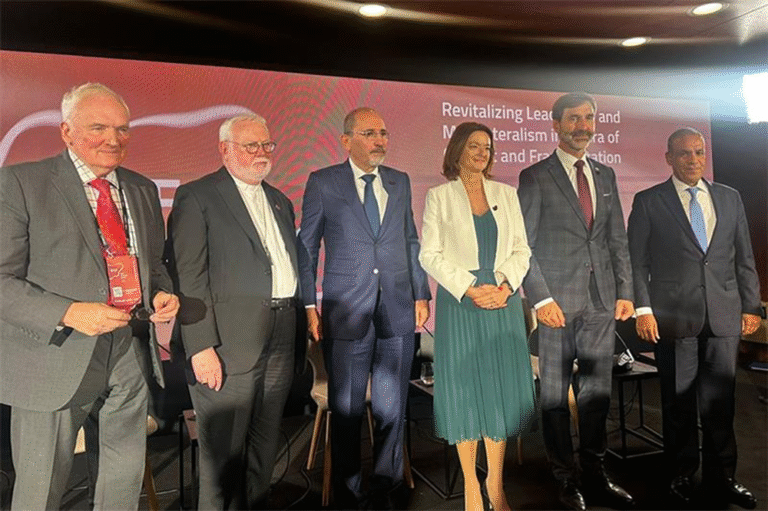
Egyptian Foreign Minister Badr Abdelatty called for a thorough reform of international institutions, which he deemed incapable of effectively responding to global crises, at the Bled Strategic Forum in Slovenia.
Traveling to Bled for the 22nd edition of the strategic forum, the Egyptian foreign minister warned of an “unprecedented” crisis of confidence in the multilateral system. In his view, the increasing number of conflicts and the growing recourse to military force reflect the weakening of dialogue and international law.
“The absence of diplomacy and dialogue, combined with the disregard for international law by some states, has weakened multilateral mechanisms,” he declared, lamenting the feeling of powerlessness of international organizations and their inability to avoid resorting to “double standards.”
Against this context, Abdelatty called for an overhaul of the international system to make it “more representative and democratic,” particularly with regard to the Arab world and the African continent. He reiterated Cairo’s steadfast support for the reform of the United Nations and the Bretton Woods financial institutions, emphasising the principle of “joint ownership” of global decisions.
The minister also reaffirmed Egypt’s adherence to the Ezulwini Consensus, which calls for an expansion of the UN Security Council and permanent African representation to correct “the historical injustice suffered by the continent.”
On the economic front, he called for a reform of the global financial architecture to increase financing capacity for developing countries and give them a greater role in international governance.
Finally, Abdelatty highlighted Egypt’s vision for the BRICS group, of which his country has been a member since January 2024. According to him, this forum constitutes an alternative platform to promote South-South cooperation, economic integration, sustainable development, and increased trade and investment flows.
By speaking in Bled on the theme of “Reviving Leadership and Pluralism in Times of Division and Conflict,” the Egyptian minister sought to position his country as a voice championing African and Arab demands in a rapidly changing international system.
MK/Sf/fss/as/APA