



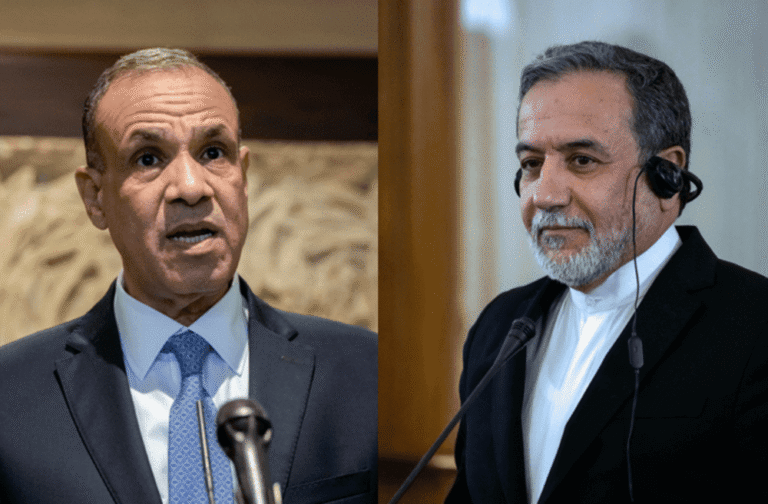
The Iranian nuclear issue was the focus of high-level diplomatic discussions in Cairo on Sunday, as Egyptian Foreign Minister Badr Abdelatty met with his Iranian counterpart,
Abbas Araghchi, and the Director General of the International Atomic Energy Agency (IAEA), Rafael Grossi. The trilateral discussions centered on the trajectory of cooperation between Iran and the IAEA regarding the nuclear matter. Minister Abdelatty emphasized the critical need to “continue efforts to contain escalation, build trust, and create the necessary conditions for continued cooperation.”
According to a statement from the Egyptian Ministry of Foreign Affairs, the goal of these efforts is to “pave the way for resuming dialogue to reach a comprehensive agreement on the Iranian nuclear program that takes into account the interests of all parties.”
Abdelatty also stressed the need to “continue the dialogue within the framework of multilateral mechanisms to support nuclear non-proliferation and strengthen global security and stability.”
The meeting comes at a time when the crisis between Iran and the IAEA has worsened. The IAEA is increasingly concerned about the transparency of Iran’s nuclear program and its stockpiles of enriched uranium, fueled by Iran’s refusal to allow full access to its facilities for inspections.
The IAEA recently called on Iran to allow verification of its highly enriched uranium reserves. In a confidential report released on November 12, the agency stated that it has lost continuity of knowledge regarding previously declared inventories since the 12-day conflict triggered by an Israeli attack on Iran on June 13. The IAEA deemed it “crucial” to verify these inventories “as soon as possible in order to allay its concerns.”
Iranian media reports indicate that Iran is currently enriching uranium to a level close to the 90% required for weapons purposes (reportedly 60%).
The head of the Atomic Energy Organization of Iran, Mohammad Eslami, has pushed back against the IAEA’s scrutiny, accusing Western powers of exploiting the agency’s information. He criticized the IAEA for its inability to prevent attacks on Iranian nuclear sites, noting that 80 percent of the IAEA’s monitoring activities focus on Iran, even though its nuclear capacity represents only 3 percent of the global total. Eslami called on the Agency to “clearly define protective measures against attacks targeting its facilities.”
Egypt has positioned itself as a mediator in this issue, having organized high-level strategic meetings in Cairo in September 2025, which resulted in a framework agreement for cooperation between Iran and the IAEA. The urgency of the current talks is underscored by the fact that the original Vienna nuclear agreement (JCPOA) officially expired on October 18, 2025, marking the end of UN Resolution 2231.
AK/Sf/fss/abj/APA