





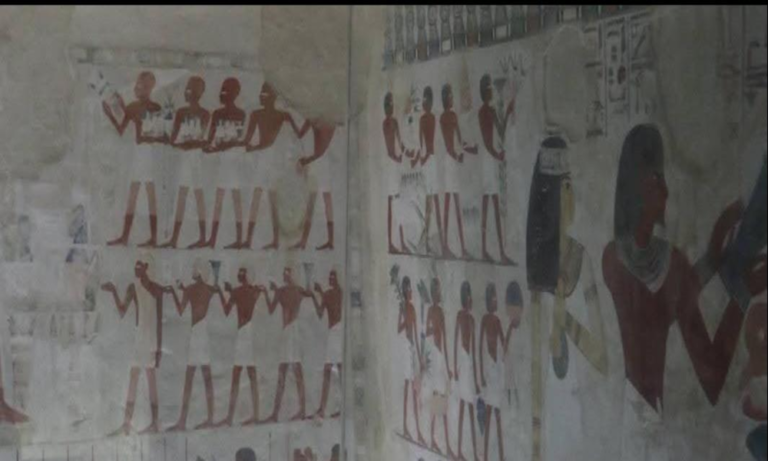
Three tombs dating back to Egypt’s 18th dynasty in the Al-Khokha necropolis are gradually reopening to the public following conservation work, adding to the country’s tourism draws.
Egypt’s Ministry of Tourism and Antiquities, through the Supreme Council of Antiquities, announced on Sunday the completion of restoration works on three ancient tombs located in the Al-Khokha necropolis, on the west bank of Luxor.
Authorities said the initiative forms part of a national strategy to diversify accessible archaeological sites and boost tourism appeal.
The move builds on ongoing efforts to promote lesser-visited sites in order to better distribute tourist flows. Minister of Tourism and Antiquities Sherif Fathy noted that the restoration goes beyond heritage preservation, aiming also to improve the overall visitor experience.
Two of the tombs, discovered in 2015, will be opened to the public for the first time, while a third has undergone an upgrade of its protective infrastructure.
The works focused on the tombs of Rabouya (TT416) and his son Samout (TT417), dating respectively to the reigns of Thutmose III and Thutmose IV. Interventions included mechanical cleaning of wall surfaces, treatment of cracks, and stabilisation of pigments depicting scenes of daily life, helping preserve the visual and historical integrity of the frescoes.
At the same time, the tomb of Nakht (TT52), a notable figure in Theban administration as a “scribe of the granaries,” underwent a technical upgrade. The glass protection system installed in the 1990s has been replaced with a high-tech solution allowing better ventilation and preservation of wall paintings. New LED lighting and wooden flooring have also been installed to facilitate visitor movement.
The gradual reopening of these tombs comes as Egypt seeks to ease pressure on major sites such as the Valley of the Kings. Located between Assasif and Sheikh Abd el-Gourna, the Al-Khokha necropolis contains more than 500 tombs of nobles and high officials from the New Kingdom.
The Supreme Council of Antiquities also plans to support this initiative with bilingual guide publications to improve accessibility for international visitors.
MK/AK/Sf/lb/as/APA