





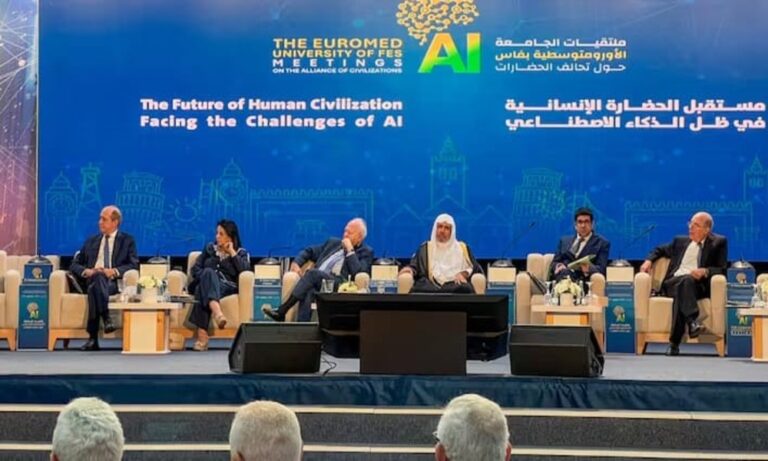
More than 2,100 participants from 74 countries are gathering at the Euromed University of Fez to examine the effects of artificial
intelligence (AI) on the future of human societies.
The Euromed University of Fez (UEMF) is hosting the Alliance of Civilizations Conference on April 27 and 28, bringing together
institutional leaders, experts and researchers to discuss the global implications of artificial intelligence (AI).
According to the organisers, 2,100 participants representing 74 countries are taking part in this international event, which features
presentations by leading political and academic figures, including the UN High Representative for the Alliance of Civilizations, Miguel Ángel
Moratinos.
From the outset, the President of the UEMF, Mostapha Bousmina, set the stage for the debate by emphasizing the scale of the ongoing
transformations. “We are witnessing the explosive development of artificial intelligence,” he declared, referring to the emergence of
advanced forms of intelligent systems.
While acknowledging major advances, particularly in the medical field, he emphasized the questions surrounding the role of humans,
governance models, and social balance. The challenge, he believes, lies in guiding these developments so that they remain at the service of collective well-being.
This stance is reflected in the sectoral impacts already observable. AI is transforming healthcare systems, improving diagnostics and
accelerating pharmaceutical research, while profoundly altering productive organisations.
The interaction between humans and machines is intensifying, which is reshaping labour markets and the skills required. These changes are
fueling concrete concerns about employment, but also about the ethical framework for technologies.
These concerns are expanding to more sensitive issues, including data management and disinformation. The speakers discussed the risks
associated with the influence of algorithms on public opinion and the dissemination of misleading content, which can affect the stability of
societies.
In this regard, Mostapha Bousmina advocated for appropriate regulatory frameworks capable of protecting personal data without hindering innovation, while also
commending the initiatives undertaken by the Moroccan authorities.
The analysis also extended to issues of sovereignty and security. The integration of AI into the military, according to the participants, represents a major
turning point, while cybersecurity is emerging as a priority.
Added to these challenges is the energy issue, as digital infrastructure and data centres require significant resources, thus reinforcing the link with energy
transition strategies, particularly in Africa.
MK/AK/Sf/fss/APA