



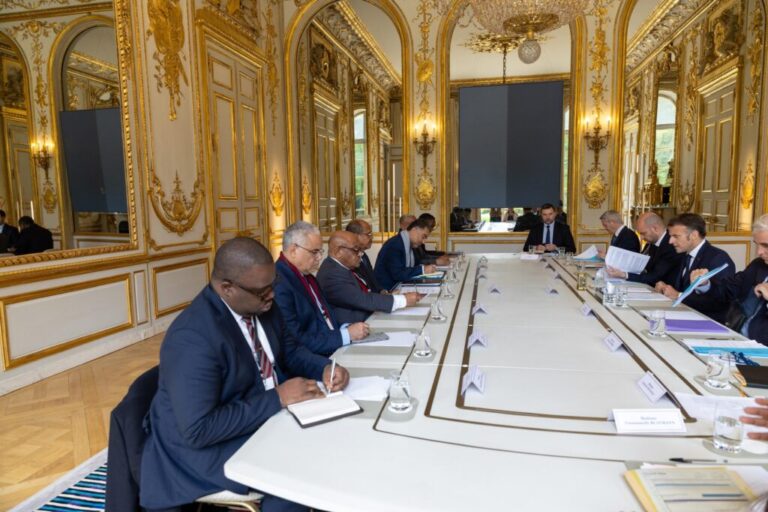
France and the African Union Commission (AUC) have reaffirmed in Paris their commitment to consolidating a strategic partnership focused on global governance reforms, the management of security crises in Africa, and strengthening economic and institutional cooperation.
The two sides held the third session of their strategic dialogue in the French capital, addressing issues related to global governance, multilateral reforms, and key security and development challenges across the continent.
French Minister for Europe and Foreign Affairs, Jean-Noël Barrot, and the chairperson of the African Union Commission, Mahmoud Ali Youssouf, reiterated their shared commitment to an international system based on respect for international law, solidarity, and more representative and inclusive governance.
Both parties stressed the need to reform the United Nations Security Council, in line with Africa’s common position as outlined in the Ezulwini Consensus and the Sirte Declaration.
They emphasised that integrating Africa’s voice into global decision-making bodies remains a strategic priority.
Talks also covered reforms of the international financial architecture, particularly regarding access to financing, debt management, and support for industrialisation and the continent’s green transition, in reference to Agenda 2063.
On sectoral issues, France and the AUC highlighted challenges related to climate, health, and water security, in line with the African Union’s 2026 theme focusing on water and sanitation.
Talks also addressed several regional crises.
On Sudan, both parties called for an immediate humanitarian truce and reaffirmed their commitment to the country’s unity and territorial integrity.
In the Great Lakes region, they emphasised the need for a political solution that respects the sovereignty and international law of the Democratic Republic of Congo, while underlining the importance of facilitating humanitarian access, particularly to Goma.
The situation in Somalia was also featured, with a call for stronger international engagement to address stability and maritime security challenges in the Red Sea region.
Both delegations expressed concern over the persistence of terrorism and violent extremism in Africa, particularly in the Sahel, and called for a comprehensive approach combining security, political, economic, and social responses.
The dialogue also covered preparations for the upcoming Africa Forward summit in Nairobi, expected to propose concrete solutions to shared challenges and strengthen partnerships between Africa and international partners.
On the sidelines of the meeting, the chairperson of the African Union Commission was received at the Élysée Palace and held discussions with representatives of African civil society and diaspora groups at the Maison des Mondes Africains.
Both sides welcomed ongoing cooperation, particularly in the implementation of the African Continental Free Trade Area (AfCFTA) and Agenda 2063, and agreed to continue their strategic dialogue at the next session in Addis Ababa.
AC/Sf/lb/as/APA