





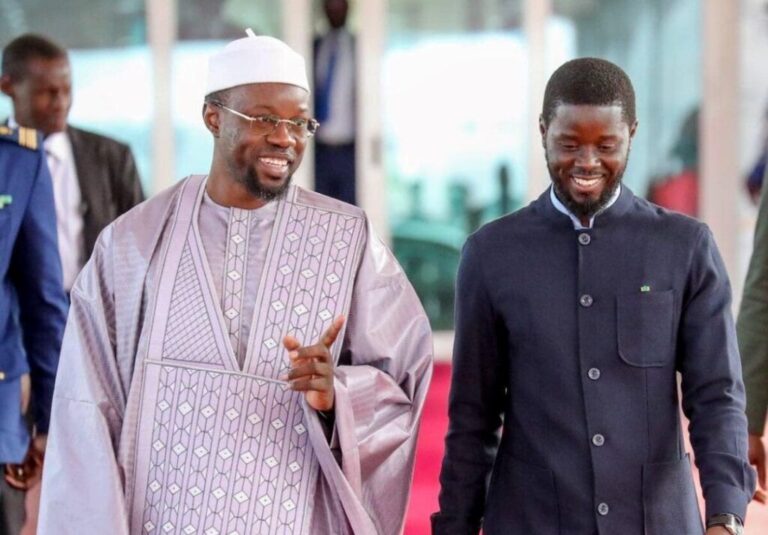
The writing was on the wall as the open wounds of a political bromance festered between Senegal’s President Bassirou Diomaye Faye and his prime minister Ousmane Sonko.
Sonko’s dismissal announced on national television on Friday follows more than a year of mounting tensions which came to a head in the intervening months and weeks.
The political trajectory of the two men is rooted in their shared history within the Pastef party. Bassirou Diomaye Faye, a former secretary-general and senior member of the movement, resigned from the party upon assuming the presidency in March 2024. He nevertheless remains politically tied to the organisation led by Ousmane Sonko, who continues to serve as its central figure.
Campaign built on political unity
Barred from contesting the March 2024 presidential election—initially scheduled for February before being postponed by former President Macky Sall—Sonko designated Diomaye Faye as his backup replacement candidate.
Released from prison following the adoption of an amnesty law by the National Assembly, the two men campaigned together under the slogan “Diomaye mooy Sonko” (“Diomaye is Sonko”), projecting a message of complete political unity.
Early fractures within the coalition
The first signs of tension emerged over the restructuring of the “Diomaye Président” coalition. In the autumn of 2025, President Faye reorganised the platform and removed Aïssatou Mbodj from its leadership, appointing Aminata Touré to coordinate the alliance.
Pastef challenged the move and continued building a parallel structure known as the Alliance patriotique pour le travail et l’éthique” (APTE), opening a first organisational rift within the ruling camp.
Two competing centres of influence
The presidential majority gradually evolved around two separate poles. President Faye consolidated support within the coalition formed during the 2024 presidential race, while Sonko rallied allies around the APTE platform.
This dual power structure increasingly shaped political and institutional dynamics, with diverging positions emerging inside the executive branch.
Public tensions and open disagreements
In July 2025, Sonko publicly called for a tougher approach in government action and criticised certain internal orientations. President Faye attempted at the time to ease tensions by insisting there was no open conflict and stressing the need to preserve cohesion within the executive.
Despite those efforts, divisions persisted and became increasingly visible through the course of the months that followed.
Escalation in early 2026
At the beginning of May 2026, President Faye publicly reiterated the constitutional powers attached to the appointment and dismissal of the prime minister, against a backdrop of internal friction and shifting political alliances.
Breaking point over political funds
The final rupture came after Sonko’s appearance during a parliamentary question time when he openly disagreed with the head of state over the management of political funds.
Hours later, an official statement announced his dismissal, along with the dissolution of the entire government he led.
In a brief reaction posted on social media, Sonko wrote: “Alhamdoulillah. Tonight I will sleep with a light heart at Keur Gorgui.”
The outgoing administration is now handling routine affairs pending the appointment of a new government.
AC/lb/as/APA