



The International Monetary Fund (IMF) and the Senegalese authorities have reached a Staff-Level Agreement on the key economic policies to support a new 36-month Extended Credit Facility (ECF) arrangement worth approximately $2.2 billion, the international financial institution announced on Tuesday.
This agreement, reached following an IMF mission to Dakar led by Mercedes Vera Martin from August 19 to September 1, 2026, is still subject to approval by the Fund’s management and Executive Board.
It is intended to support Senegal’s economic and financial reform programme for the period 2026-2029.
The envisaged amount corresponds to 1,537.1 million Special Drawing Rights (SDRs), or approximately 475 per cent of Senegal’s quota with the IMF.
Restoring the sustainability of public finances
This new programme comes at a particularly sensitive time for Senegal’s public finances. The authorities are seeking to restore macroeconomic stability and bring public debt back onto a sustainable path, while preserving social spending and the conditions for sustainable growth.
The strategy presented to the IMF relies in particular on increased domestic revenue mobilization, better control of public spending, and strengthened debt management.
Senegal also plans to improve the monitoring of domestic arrears and the supervision of state-owned enterprises.
The government also intends to strengthen social protection mechanisms, notably through targeted cash transfers, so that fiscal consolidation does not disproportionately burden the most vulnerable households.
An agreement subject to several conditions
The agreement reached at the staff level does not yet mean the immediate release of funds. The IMF specifies that its approval requires, in particular, the implementation of decisive corrective measures related to the previous case of misreporting.
Senegal will also have to obtain the necessary financing assurances from its partners before the programme is reviewed by the IMF Executive Board.
The institution emphasizes that further action will be needed to address past reporting issues and strengthen safeguards to prevent a similar situation from recurring.
The programme should also help mobilise additional financing from the World Bank, the African Development Bank (AfDB) and other development partners.
An economy driven by hydrocarbons
Despite pressures on public finances, the IMF notes the resilience of the Senegalese economy. The country recorded real growth of 6.7% in 2025, driven in particular by the first full year of oil production.
However, this performance masks a more mixed picture in the non-hydrocarbon economy. Non-oil and gas GDP growth slowed to 2.2% in 2025 before rebounding to 4.7% in the first quarter of 2026, supported primarily by strong private consumption. Inflation, for its part, remains contained, settling at 1.4%, according to data cited by the IMF.
This trend illustrates one of Senegal’s main economic challenges: transforming hydrocarbon revenues into a sustainable driver of development, while ensuring that dependence on these new resources does not mask the persistent weaknesses of non-oil sectors.
Towards a new revenue mobilisation strategy
Among the announced reforms is the adoption, in 2027, of a medium-term revenue strategy designed to sustainably increase tax revenues and create more fiscal space to finance national priorities.
The authorities also aim to improve the business environment and strengthen financial inclusion to foster more private-sector-led growth.
The IMF believes that these structural reforms should complement fiscal consolidation efforts and help strengthen the foundations for medium-term growth. Debt restructuring now on the table.
Another major element of the programme: Senegal has announced its intention to seek debt restructuring to restore its sustainability.
This prospect comes at a time when the issue of debt has become central to the country’s economic policy. The stated objective is to free up sufficient budgetary space to allow the government to continue financing priority sectors, particularly social spending, while respecting its financial commitments.
The success of the new programme will therefore depend as much on securing external financing as on the authorities’ ability to implement the announced reforms and enhance transparency in public financial management.
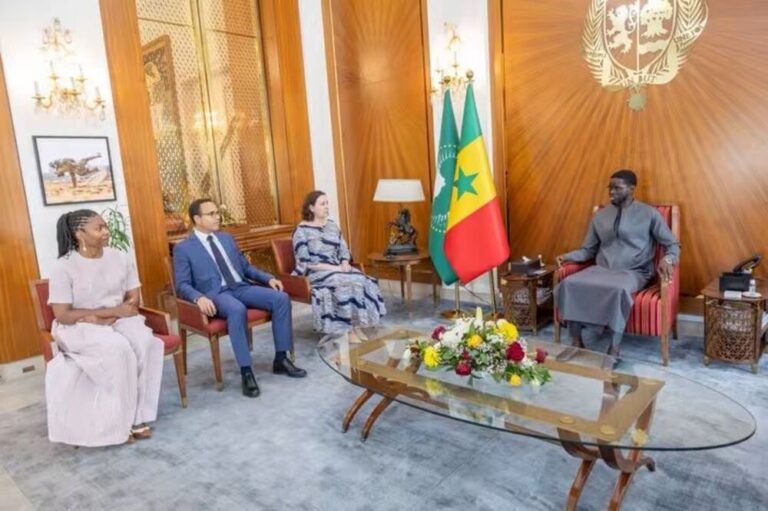
During its mission, the IMF team met with the President of the Republic, Bassirou Diomaye Diakhar Faye, Prime Minister Ahmadou Al Aminou Lo, as well as several members of the government, officials from the Court of Auditors, and the regional apex bank (BCEAO)
It also held discussions with development partners, representatives of the private sector and civil society.
The agreement that cropped up on Tuesday, thus marks a new milestone in relations between Senegal and the IMF. Its approval by the Fund’s governing bodies will now be crucial in enabling Senegal to receive the planned financial support and fully implement its reform programme for 2026–2029.
TE/fss/gik/APA