





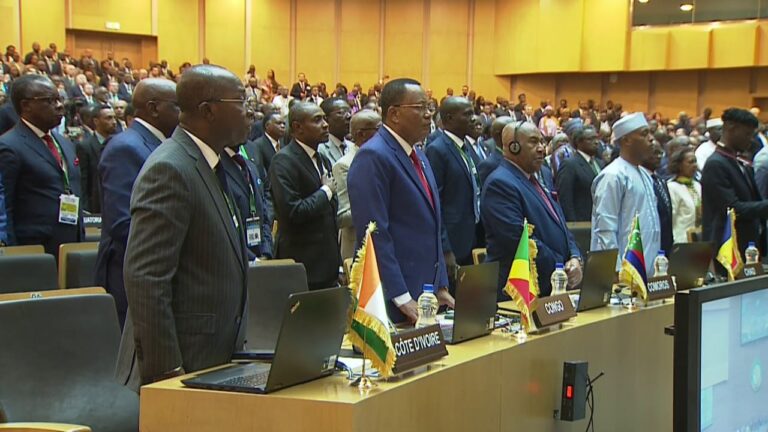
Instability across the continent, climate and water crises and other challenges are some of the themes exercising the minds of participants at the 39th ordinary session of the Assembly of Heads of State in Ethiopia over the weekend.
The meeting opened at the AU headquarters in Addis Ababa, the capital of Ethiopia on Saturday and will interrogate burning issues affecting countries on the continent.
The two-day summit, which brings together leaders from AU members, was launched under the AU’s 2026 theme: “Assuring Sustainable Water Availability and Safe Sanitation Systems to Achieve the Goals of Agenda 2063.”
Aside from emphasising the need for sustainable water management, delegates also discussed a range of issues, including peace and political stability in troubled spots such as Sudan, Libya and the Sahel, economic development, regional integration, and efforts to strengthen Africa’s global standing and unity in the face of shifting geopolitics.
Opening the session, the chairperson of the African Union Commission Mahmoud Ali Youssouf said unconstitutional changes of government are resurfacing, reminding us of the dark days following independence.
“Our summit is taking place in a geopolitical context of crisis, both on the continent and throughout the world. Silencing the Guns on our continent remains a challenge,” Youssouf told African leaders.
Acknowledging the political and institutional fragility of several African countries as a source of continental concern, he said “open and latent conflicts are becoming chronic.”
“Unconstitutional changes of government are resurfacing, reminding us of the dark days following independence,” he said.
Highlighting the situation in Sudan, eastern Democratic Republic of the Congo, and Somalia, among others, Youssouf said “our peoples continue to pay a heavy price for instability.”
United Nations Secretary General António Guterres said developed nations must deliver on their commitments and finance developing countries with 1.3 trillion U.S. dollars a year by 2035 to deal with climate adaptations.
The Secretary General was at the summit Addis Ababa.
“Adaptation must be a priority. This requires developed countries tripling adaptation finance, mobilising 1.3 trillion U.S dollars a year for developing countries by 2035 and scaling up the loss and damage fund,” Guterres said.
He said the G20, which comprises 19 countries and the European Union, contribute to close to 80 percent of global emissions. “They also must deliver major emission reductions this decade,” he said.
The opening session drew African heads of state and government, alongside leaders of continental and international organisations such as the UN.
MG/as/APA