



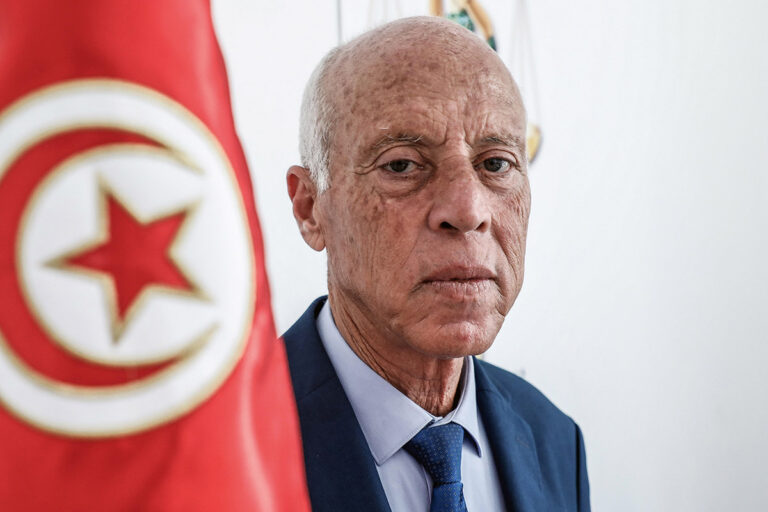
The attempted assault on the UGTT headquarters on August 7, followed by the head of state’s public support for the protesters, revived concerns about a repressive turn against trade union freedoms in Tunisia.
The social climate suddenly became tense following this attack, which marked a new stage in the open confrontation between the presidency and the trade union federation.
Kais Saied raised the possibility of criminalising certain union actions, a threat interpreted as an attempt to weaken the UGTT, a central player in Tunisian social and political life since independence.
This offensive comes in a context of broken social dialogue and heightened authoritarianism. Since his constitutional coup on July 25, 2021, Saied has ruled by decree, marginalising parties, parliament, and intermediary bodies.
After silencing the political opposition and intensifying pressure on journalists, the head of state is now targeting organized trade unionism.
Faced with this trend, several French trade union organisations – CFDT, CGT, Unsa, Solidaires, and FSU – on Wednesday condemned “a campaign of intimidation against the UGTT” and expressed their solidarity with their Tunisian counterparts.
In a joint statement, they called on the French government and the European Union todenounce these attacks on fundamental freedoms and to reconsider their support for the EU-Tunisia memorandum.
The UGTT, founded in 1946 and co-winner of the Nobel Peace Prize in 2015 for its role in the post-revolution democratic transition, remains a key force in the country. She announced the organisation of a large rally on August 21 to defend freedom of association and reiterate its role as a social countervailing force.
French unions emphasise that the Tunisian authorities are required, under the international conventions of the International Labor Organization (ILO), to respect Convention 87 on Freedom of Association and Protection of the Right to Organise, as well as Convention 98 on the Right to Organise and to Collective Bargaining.
The confrontation between Kais Saied and the UGTT illustrates a new stage in the regime’s hardening, where the challenge to democratic gains is now coupled with an offensive against trade union freedoms, the last bastion of resistance to the presidential power.
MK/Sf/ac/fss/as/APA